
by Cate McGowan
Little Sting
The world ended in the food court, right when I was lining up three eight-year-olds, triplets, for cartilage piercings at the Piercing Pagoda kiosk. Their mother, dressed head to toe in rhinestones, said, “Don’t make the holes uneven.”
Then came the popping.
Not bombs at first. Smaller. Meaner. Personal.
A party store’s balloons went off in a chain reaction so fast it sounded like applause. Someone’s breast implant surrendered in a dressing room at JCPenney. A display wall of Funko Pop boxes keeled over in GameStop, and all those dead-eyed little plastic heads rolled out underfoot. The man at the cell phone case stand dropped to his knees, clutching his molar. Across from Auntie Anne’s, every fluorescent tube in the ceiling burst at once and rained a fine white dust into the cinnamon sugar.
People screamed shooter, because people always call a thing by the name they already know.
But the pops kept coming. Tires blew in the parking lot. The nail salon lost its front glass in one bright shatter. Soda lines at the Sbarro snapped, spraying brown syrup. The mall cops’ security radios crackled, then gave a little kiss of static and died. On the giant video screen above the escalator, a pop star with chrome eyelids froze mid-wink, her face pixelating into fat pink squares before the whole projection blinked black.
I still had the piercing gun in my hand.
That part matters.
I was trained to make a neat wound in soft flesh while smiling and asking about school. Breathe in, honey. Little sting. Gorgeous. I knew something about fear dressed up as adornment. I knew how a hole can turn into a portal if everyone agrees to call it jewelry. What I didn’t know was how fast that voice would rise in me, trying to soothe somebody, anybody, with the ceiling bursting and people screaming, how badly I wanted to calm them so I wouldn’t have to feel the fear in my own hands.
By the time the men from mall security started shouting orders, the girls from Claire’s had already yanked down the grate. I ran from the Pagoda with the piercing gun in my hand. Me, Didi from the pretzel counter, a college boy with gold eyeshadow and high tops and a nametag that said Nate though later he told us he preferred Saint, two sisters from the sneaker store, a grandmother carrying six tubes of Wet n Wild lipstick in her purse for reasons that soon became obvious, the pregnant manager from Bath & Body Works, and a silent child in a JoJo Siwa bow the size of a dinner plate. All of us got inside.
Somebody yelled for us to open up.
Somebody banged the grate with a flashlight.
Somebody said, Ladies, be reasonable.
That was the first funny thing that happened after the end.
Inside Claire’s, the air smelled of fake strawberries, nickel, hot plastic, and that powdery sweetness cheap makeup has when it wants very badly to be mistaken for youth.
We barricaded the grate with spinning racks of scrunchies.
Didi inventoried the snacks. Stale pretzel bites. Two lollipops from the register bowl. A family bag of gummy sharks. Three hidden cans of rosé that Saint found under a shelf of friendship bracelets because the apocalypse reveals character, but also storage habits.
The grandmother emptied her purse. The lipsticks first. Then the rest: mini scissors, safety pins, sewing kit, hard candy, a tiny Swiss Army knife, a roll of mints, a packet of birth control pills she said she no longer needed but liked to keep “out of spite.”
The child in the enormous bow reached out and touched the wall of earrings, hundreds of tiny moons and cherries and knives and lightning bolts pinned to velvet cards.
“Pretty,” she said.
Outside, the men got louder. They’d found golf clubs from Dick’s Sporting Goods. They’d found purpose. Nothing bulks up faster than frightened masculinity with access to sporting equipment.
They said they were forming a plan.
They said women and children would be protected.
They said open up.
The pregnant manager, whose name was Luz, climbed onto the counter and clicked on the mall intercom with the authority of a woman who had once handled Black Friday candle violence.
Her voice filled the dead mall.
“Attention shoppers,” she said. “The patriarchy has been moved to clearance. No further assistance needed.”
That was the second funny thing.
After that, we got organized.
Saint used rhinestone letter stickers to make signs:
NO GODS NO KIOSKS
ALL SALES FINAL
IF YOU WANT IN, SHOW US YOUR CUTICLE CARE
We slept under feather boas and on novelty pillows shaped like lips. We ate gummy sharks one by one, biting their heads off first because it improved morale. The child finally told us her name was Cricket. Didi taught her how to knot a pretzel from imaginary dough. Luz timed her contractions by the old fountain clock, even after it stopped. The sisters from the sneaker store stripped the elastic from sequined headbands and used the strands to rig a slingshot. The grandmother, who said we could call her Baby though she was seventy-three, melted lipsticks together in a ceramic ear-piercing dish and made war paint the color of a fresh insult.
We waited until around three most mornings to sneak into the food court and raid the back rooms: frozen pretzels from Auntie Anne’s, dented cans from Sbarro, rice-and-sauce packets from the teriyaki place, warm bottles from vending lockups that somebody pried open. For a while, the family restroom still gave us water if we held the handle just right. After that, we filled buckets from a maintenance sink in the service hall.
By then the air under center court had gone stale and swollen, and every time I looked up at the cloudy plastic dome above us, I thought of a blister waiting for a nail.
And the pops kept happening beyond the grate and beyond the mall. On one of our early water runs, we eased open the loading-dock door and saw the interstate beyond the parking lot stalled into silence, six lanes of cars sitting there with their doors ajar like people had stepped out mid-errand and forgotten the rest of civilization.
After that, the stories got bigger and stranger. Cities gone soft. Overpasses split. Birds dropping out of the sky like bad ideas. Banks, apparently. Transformers. A governor on live television. A dam somewhere out west. A thousand champagne corks at a celebrity wedding no one would ever finish streaming.
Men outside Claire’s had begun dividing the mall by department, assigning jurisdictions. Food court. Housewares. Men’s. Firearms, though there had never been firearms in our mall. Men always add a fantasy department first.
Outside was all exposure: stalled cars, broken glass, heat, men with plans. Inside we had a grate, a sink, and walls we knew how to move through. We called it not stepping into the first bad system that announced itself as rescue.
In week four, a teenage boy in football pads crawled up to the grate and said very politely that his father was in charge now, and girls weren’t safe by themselves.
Saint crouched and looked him in the eye through the metal lattice.
“Sweetheart,” he said, “have you met girls?”
Inside, Baby was busy teaching Cricket to load the piercing gun.
She practiced.
Not on any ears.
On stuffed unicorns first. Then folded towels. Then the padded heel of a sneaker. The little mechanism made its clean, efficient click.
Pop.
Pop.
Pop.
At night, we held our own broadcasts.
Luz read ingredient labels from body sprays as if they were prophecy. Didi recited the names of all the men who had ever told her to smile while handing over salted dough, her hands burned raw from the oven. The sisters performed a duet in which they rewrote every boy-band lyric into labor demands. Cricket marched through the store wearing six tiaras and announcing promotions. Saint demonstrated contouring as tactical camouflage. Baby told us how, in 1978, she’d stabbed a city councilman in the hand with a hatpin when he tried to slide his palm up her thigh under a banquet table, and how the only real mistake she made was apologizing after.
I sat with the piercing gun in my lap and thought about all the times I had used my voice to minimize, to soothe, to make the piercing wounds feel like a choice. I thought about how many times I had been the one smiling while someone else braced.
We laughed too hard. We cried, too, mostly from annoyance.
One day, the men tried to cut the grate.
That was their mistake.
Claire’s sells enough cheap mirrored compact cases to blind a small militia if angled just right. Enough aerosol glitter spray to turn the air punitive. Enough sharpened hair sticks to make a point.
When the torch came near, Saint and the sisters hit them with glitter first. A pink storm. Then pretzel salt in the eyes. Then Baby, serene as a church, lobbed a mason jar of molten lip gloss Didi had warmed over a candle wick. It exploded across the floor and sealed itself around one man’s ankle so completely he had to leave his shoe behind, hopping, cursing, sock steaming and soaked in peach shimmer.
The men scattered.
We opened the grate that night on purpose. Not wide. A throat’s width. Enough.
People came.
A cashier with split knuckles. Two nursing mothers. One exhausted dad carrying twin girls in rain boots. A woman in office clothes with a wedding-set imprint on her ring finger, but no rings. A trans girl from the movie theater with mascara tracks down her face and a backpack full of Milk Duds. An old janitor who said only, “I have keys,” and held them out to us like an offering.
We let in those who knew how to enter.
Weeks later, when the pops had grown rarer and more distant, when the mall smelled of fryer grease gone cold and damp carpet and the sweet, rank musk of people staying alive together, we stopped keeping count of who was inside. Cricket had grown two inches, or seemed to. Didi had taught half of us to braid. Luz had a baby, and we weren’t sure how to talk about it. There was blood, of course, and swearing, and then a furious little voice where there hadn’t been one before. She named the very loud girl Ruby.
One morning, I woke up and couldn’t remember what the outside smelled like and, for a moment, felt free.
None of us could stand another day under that blister of a sky.
That’s when we climbed through Maintenance into the crawlspace above center court.
Overhead, the giant plastic bubble had gone cloudy with soot. It was the last round object in the place. Taut. Waiting.
Cricket asked if she could do it. For a second, I saw every little ear I had ever steadied, every flinch I had talked past with my bright mall voice. Then I handed her the piercing gun.
She aimed at the heart of that filthy dome with both hands, tongue caught in the corner of her mouth, serious as a jeweler.
“Breathe in, honey,” I said. “Little sting.”
Then she pulled the trigger.
The bubble split wide with a sound too big for the old world, and rain came down through the hole, hard and ecstatic, washing glitter from our hair into our eyes, our mouths, the grout between the tiles below, until the whole dead mall flashed like a fish.
We stood there open-faced in it.
Ruined.
Gorgeous.
Author Cate McGowan (she/her) is the author of four books, including the story collection True Places Never Are and the poetry collection Sacrificial Steel. Her work appears in Flash Fiction International (W. W. Norton), Glimmer Train, Shenandoah, North American Review, and elsewhere.
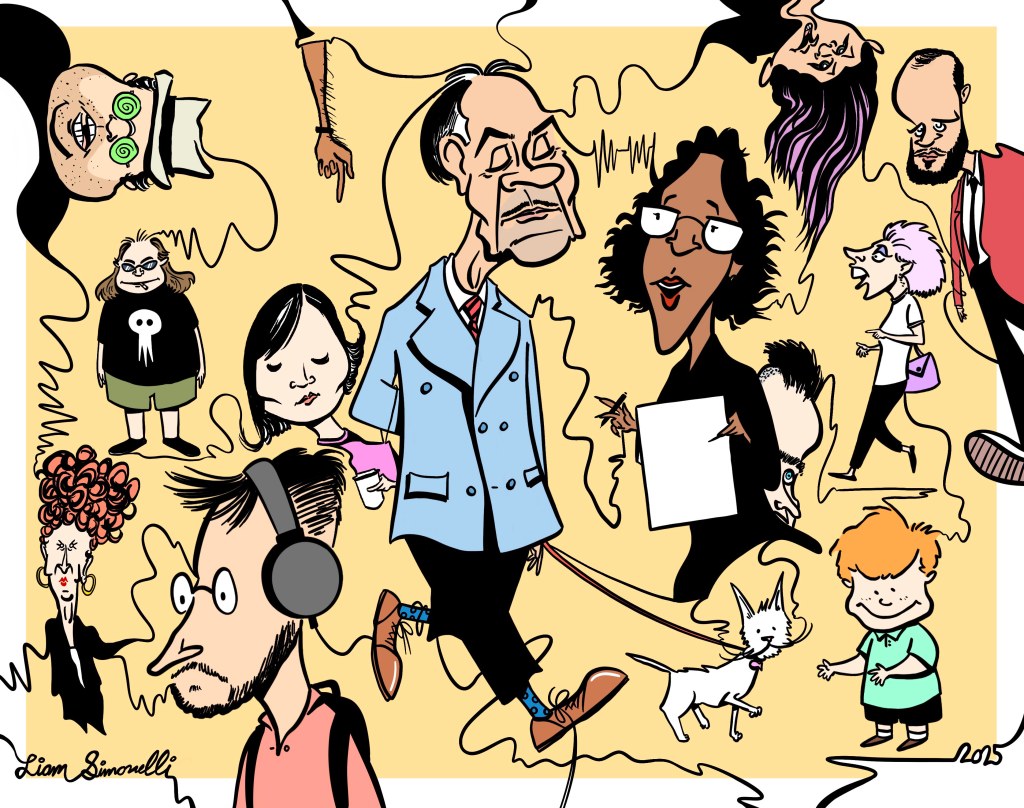
Artist Liam Simonelli (he/him) is a cartoonist and illustrator located in his home state of New Jersey. He is 23 years old and has been drawing since he was four. He holds a Bachelor of Fine Arts with a specialization in Graphic Design from The College of New Jersey. Prior to that, Simonelli graduated from Mercer County Community College with an Associate’s Degree in New Media Communications. He has had his work featured in numerous publications across the country. These include The Washington Post, Politico.com, The Star-Ledger, Speciality Chemicals Magazine, The Tampa Bay Times, The Dayton Daily News, The Staten Island Advance, The Jersey Journal and more. He is a member of the Association of American Editorial Cartoonists (AAEC).

