
by Lexi Gomis
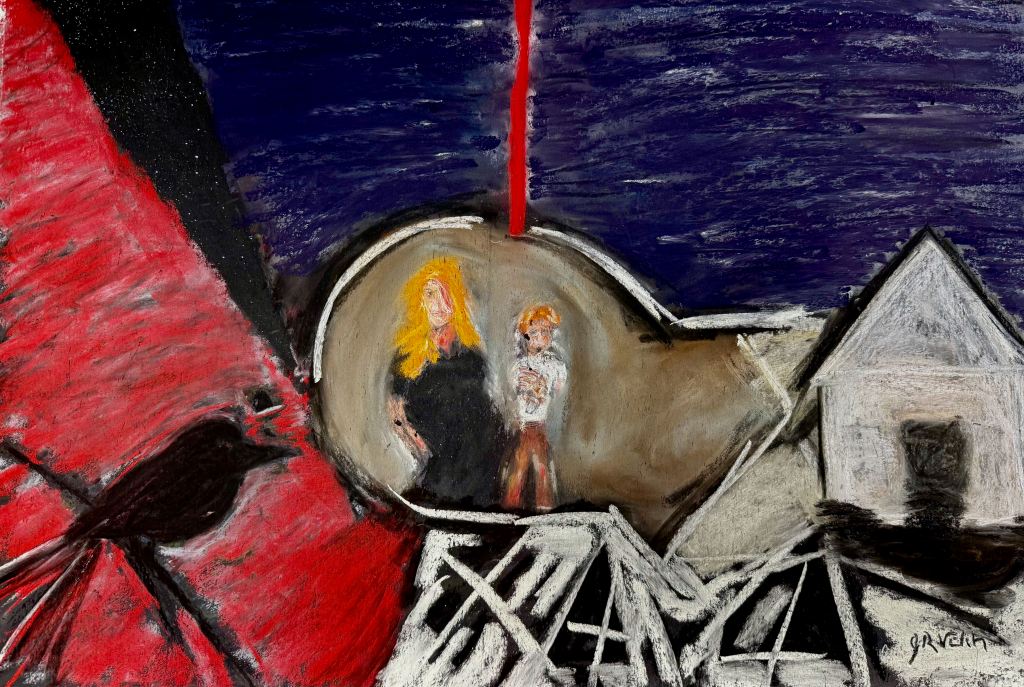
Event Horizon
Max wakes up before I do. He tests the knob on the bedroom door, then knocks. “Are you awake?” he says. “I’m hungry. I’m actually kind of starving.”
He is obsessed, I think, with starving. This and outer space, which he tells me is a vacuum, filled with a crushing sort of pressure that would end my life instantly if I were ever caught in it outside of a space suit. I would not have better luck on the moon, he tells me, because I wouldn’t be able to breathe there. Nor on Mars, where I would also freeze. But on Venus, he says, I would be incinerated. Vaporized. Melted, but so quickly I wouldn’t feel a thing, and then I’d be just particles, microscopic, too small for anyone to see. He says this would not hurt.
For the past six mornings, this is what we’ve done: he comes to wake me, and when I get up, he tells me how I will die.
When I open the door, he brushes past me and begins straightening the sheets. He tells me, hunger temporarily forgotten, that he’s been reading about black holes. I close another door between us—the bathroom, now—and his voice follows me. I wouldn’t want to be caught in a black hole, he warns. It would be disastrous. There would be no coming back. “Your feet would move faster than your head,” he says, and there is no lightness in his voice as he goes on. “You’d stretch to infinity.”
The bathroom counter still has a spread of fine black hairs near the mirror, an old electric razor still plugged into the wall. There is a smear of dried blue toothpaste along the side of the sink that, when I look at it directly, turns my stomach.
The edge of a black hole, Max is now saying, is called the event horizon. This is the spot from which nothing escapes, from where there is no going back. This spot is sort of magnetic, in that the gravity is so strong it pulls in anything that gets near. It’s impossible to avoid. Light can’t escape it. He asks if I’m still listening.
“Event horizon,” I repeat back. The faucet squeaks when I turn it on, and the water sputters on; it takes several seconds before the stream is at full force. “What’s the event?”
A shadow appears at the crack under the door. “The beginning of the black hole,” he says, his voice raising. “That’s what I’m telling you.”
“Right.” I cup my hand beneath the water and close my eyes, then splash it onto my face. The towel I have been using is frayed at the corners, and it is rough against my skin. “But how does it start?”
When I open my eyes again, his shadow has disappeared. I brush my teeth and turn off the faucet. My brother’s toothbrush, at least, is gone; he must have packed it, along with—as best I can tell from going through his dresser—every pair of socks he owned.
This is the only bathroom in the apartment, and periodically Max locks the door and does not come back out for a long time. He is old enough not to need help, he says, but he is still small enough that he struggles to reach the faucet without the stepstool he dutifully drags from beside the toilet and returns once he’s finished.
Once, I needed to pee while he was in there, so I went down the street to the gas station. When I came back, he was waiting for me. He told me it was irresponsible to leave him alone, and at least I should tell him before I leave.
This morning, I find Max back in his room, one of his books in his hands, and he looks up at me when I pause in the doorway. His face is my brother’s, an echo from three decades ago. I can’t seem to take a deep breath.
“They skipped the beginning,” Max says. He can’t figure out how the black hole starts. All he knows is that it does.
My brother’s coffee maker is broken, so we go out every morning. The barista today is one we haven’t seen before, and she tells Max he can have a free donut hole if his mom says it’s okay.
He looks at me. “She’s not my mom.”
“Oh, no?” the woman says, and she looks at me too. I open my mouth to explain, but Max beats me to it.
“My mom lives in Florida with her other family,” he says.
The barista is now looking at me like he’s said something vulgar, like she wants me to make him apologize. But I just say, “In Pensacola.”
The next questions would be the wrong ones: How could she leave him? Or why?
No one asks. No one ever asks the third question, either, which is where Max’s father is, or the question even I haven’t asked, which is whether on the day my brother left and told Max to lock the front door behind him, did he also tell his son to call me, or did the boy decide to do that himself?
“I want the chocolate one,” Max says, pointing behind the counter. “Please.”
When we were children, I remember, my brother didn’t like chocolate. I want to ask if this is still the case, but I stop myself because I don’t want to upset Max.
No, that isn’t true. I just don’t want to know.
Max says that he appreciates my scrambled eggs, but if he has to eat them for breakfast one more time, he’ll throw up. When I remind him I can make toast, too, he pretends to gag. We agree to go out for breakfast, then, to the place he goes with his dad for his birthday.
The diner is down the street from their apartment, and the waitress who seats us knows Max’s name. She glances at my takeout cup of coffee but doesn’t say anything about it, and to be polite I order a cup from her.
I look around, as if I might see what my brother has seen here, as if I might understand him just by sitting where he is supposed to sit. Max points to the advertisements from local businesses on the back of the menu, and I can’t tell if he’s reading the names or just has them memorized. One name is his teacher’s husband, he says, and that’s who they’re going to buy a house from. Eventually.
“But they don’t sell houses in a store,” Max clarifies. “It’s very different. You can only buy them from a guy like that.”
At the mention of his teacher, I flush. Between the card games and the facts he recites to me, and the shows we let play on the old TV, I have forgotten about school entirely.
“Tomorrow’s Monday,” I say, stupidly, and Max seems to follow my thoughts.
“I have to go back to school.”
He is six, in the first grade, and I know this, I knew this, my brother had sent me his school photo months earlier. It’s April, not summer. As long as I have been away from work, perhaps longer, Max has been out of school. I wonder who they have been calling.
Because he is giving me an opportunity to pretend I have known this all along, I nod. “It’s time,” I agree, and I scan the menu more because I don’t want to meet his eyes. “Is there a bus? Or does your dad drop you off?”
“I can walk,” he says. “My school is close. I know how to get there.”
The thought is shocking, that a small boy would walk there by himself, but I don’t know how to push back. I ask if I can walk with him tomorrow.
“There are other kids,” he says. “I can walk with them.”
I ask if I should call the school, at least, maybe first thing in the morning. Explain that he’s been with me for the past week, so he doesn’t have to answer any questions when he gets there. But Max says he doesn’t want me to tell them about his father. I swear the earth cracks open at my feet, the tile beneath us splitting apart and swallowing the booth, but my brother isn’t there to be swallowed. It’s just us. Me.
“I’m sure this kind of thing happens all the time,” I say.
Max ignores this and asks if he can get chocolate chip pancakes.
When it’s time to pay, we stand in line at the cash register and Max asks to hold the check. He pretends to, or really does, read the charges.
“Look okay?” I say, and he nods. He asks if he can hand them my card, which I agree to, and when the cashier hands it back Max slips it into his pocket.
“You know,” he says, folding our receipt, then folding it again. “You can live for three weeks without food. It actually takes a while to starve.” He runs a fingernail over his last crease, cementing it. “I shouldn’t have said that, before. That I was starving.”
He says he learned this from a show he watches with his dad. The contestants are dropped off at the woods—that’s how he says it, at the woods—and they have to survive for a week on only what they can find or hunt or catch.
“Otherwise they die,” he explains, and while I know this can’t be true, I don’t correct him. The show keeps filming, even if a contestant doesn’t eat for all seven days, and in those cases Max says they mostly just lay down until the week is over. He corrects himself: “Well, they chew on leaves. Or tree bark.”
The only time the show ends early is if they don’t find water. This, he says, is embarrassing; everyone knows they should find water first, but some people get too caught up building a shelter or setting up animal traps. He tells me they once saw a contestant let an entire rainstorm pass without collecting any of the water, because he was so focused on building a fire in his lean-to.
“But I wouldn’t let that happen,” he says, taking my hand as we cross the street. “We’ve talked about it. I would find water first.”
I try to laugh, looking both ways, but it comes out fake and I know he can tell. “Why would anyone sign up for that?” I say, and Max drops my hand once we’re back on the sidewalk.
“I forgot to tell you,” he says, “I remembered how a black hole starts. It was in a different book.” He leads us up to the apartment building, then to the stairs, and as we climb, I ask him how it happens.
“A star dies. Then everything around it dies.”
I tell him this sounds morose, and he doesn’t know what that means, so I try to define it. But my explanation seems silly—all I can remember about the meaning of the word is that it has to do with death.
“That’s what I’m telling you,” he says. “The star dies. But it takes a long time. Billions of years.”
“Except if I were to get near one,” I start, as we near the front door.
“Instantly,” he says.
When his wife left, my brother called me. Max was two months old. My brother could not get out of bed, he said, and after I arrived he did not get out of bed for weeks.
I slept on their couch and drowned in diapers, formula, burp cloths and swaddles. Max ran a fever at one point, and for two days I camped on the floor beside his bassinet, listening to him fuss and brushing his forehead with the back of my hand to check his temperature every few minutes.
I did not leave until my brother promised he was better, that he could look after Max himself, and he would call me again if anything changed. While I packed my things, drove back to the airport, boarded my flight home, and returned to my own bed, I pretended not to know this was a lie.
This time, I only slept on the couch for the first night. Then Max and I washed the sheets, and the towels, and the pile of laundry in the closet, and I moved into my brother’s bedroom.
When he returns, Max warned, I would have to move back to the couch. But for now, he said, this was okay.
We make spaghetti with jarred sauce for dinner. Max asks me what meatballs are like, because he’s seen them in books, but he can’t remember if he’s ever eaten one.
I tell him I’m sure he has, and then he’s sure he hasn’t. He wants me to tell him about them.
“I don’t know,” I say. “They’re fine. Chewy.”
He squints at me, his mouth pursed. “Chewy?”
“Meaty.”
“Meaty?”
“I don’t know. We can make them sometime. Then you can see for yourself.”
He considers this, twirling his fork through the noodles on his plate, before agreeing that this could work. He calls it a compromise.
Max’s mother calls after we’ve finished, while I am washing the dishes and Max is supposed to be brushing his teeth. I grab the phone off the wall and, after I say hello, there is a pause while she remembers my name. She says it, confused, and then I say hers. We both fall silent for a breath.
She remembers herself first and asks where my brother is; when I say I don’t know, she asks if he called me.
I ask who called her.
The school, she says. Last week. She was away and just got the messages on her machine; she has apparently been added as an emergency contact for Max. “I don’t know why your brother would do that,” she says, and I agree. She asks me to make sure the school removes her.
“I’ll try,” I say.
“You didn’t notice anything?” she says.
“I didn’t notice anything.”
When I hang up, Max comes back into the kitchen. “I noticed a few things,” he says. He lists it off: coffee without sugar, headaches, shaving.
“I don’t think any of that’s anything to worry about,” I say.
“It’s not?” he asks, and I can’t answer honestly, because I don’t know.
Because Max is the one who called me. Because his father packed a bag and left. Because it’s too late for whatever we should have worried about.
I know better and still I let Max walk himself to school. I have the foresight to pack him a peanut butter sandwich, at least, though the jam in the fridge is moldy and he pretends not to mind that we can’t use any. I throw it out and promise to buy more.
When he returns in the afternoon, I tell myself, I will hold onto him and not let him out of my sight. What kind of an idiot lets a six-year-old walk themselves to school. What kind of an idiot assumes it will be fine.
It is fine, of course, and Max comes home with more to tell me. They are learning about the water cycle, and he is behind, but he sort of gets it. The gist, he says, is that water never disappears. Not really. It is always in the clouds, or the ground, or the rain, or the atmosphere. It is always somewhere, even when we don’t see it, even when we think it’s gone.
I walk him to school the next day, watch his neon green backpack disappear through the gates, then return to the apartment and call my work and ask for more time off. They aren’t happy. I say that I am having a family emergency, and it is taking longer than expected. They ask for more details, for when I think I will return. I say I have to call them back.
Then I begin what I’ve avoided, which is to call around the hospitals in the area. Two have never heard of my brother. One says he was a patient in their emergency department, but that was five days ago. They can’t tell me more than that.
“I’m his sister,” I say. “I’m watching his son.”
They imply that I might want to call the police. That the man they treated seemed near to an episode, and if they’d had the space, they might have admitted him.
When Max gets home, he says we need to make the meatballs soon. That he wants to make them a few times, to practice them, so he can show his dad once we’ve got them down. That his dad will want to try them.
But not tonight; tonight, he says, he really has to catch up on his homework, so we should probably go to McDonald’s. I agree, because I don’t know any better, because it sounds reasonable, because I’m not ready to tell him about my day. About what I’ve learned.
I offer to help with his homework. “I can do it myself,” he says, not unkindly. “But you can check it.”
That night I dream that Max is in one lifeboat, and my brother is in another. There is a whirlpool between them, and it is coming for me. I am one of the lifeboats. I cannot remember which one.
Max is up before me again, and this time he does not wait for me to wake; he comes in without knocking and taps my shoulder beneath the blankets.
“I need to tell you something,” he says, and as my eyes adjust to the light leaking in from the hallway, I can see the circles beneath his eyes.
I ask what time it is; there is no sunlight beneath the curtains. We both look at the alarm clock and I answer my own question; it’s four-thirty in the morning.
Looking back at him, I see that Max is already dressed for school. “I need to tell you what I just read,” he insists. It’s about Jupiter. A storm on Jupiter the size of our entire planet. “Which is Earth,” he says, in case I am not aware.
I move backwards, motioning for him to come beside me, and am surprised when he does. He nestles into me, his shoes on top of the blankets, his breath sweet and hot against my face.
It’s not a regular storm, he says. The lightning is so intense that when it strikes, it turns gas into solid, and solid into diamonds. He asks if I’m still awake; my eyes are closed again.
“Diamonds,” I say. “You’ll be rich.”
I feel him shake his head. It isn’t like that, he says; they melt as soon as they land.
“You’d melt, too, as soon as you got there. Or you’d be burned up into nothing. Not nothing,” he corrects, “Just tiny particles, microscopic, so small—”
“No one would be able to see me,” I say. “You told me this on Venus.”
“This is different,” he says, and one of his hands finds my face. I hold still.
“Different how?” I ask.
“This would hurt.”
Author Lexi Gomis (she/her) is an emerging writer with an MFA from Warren Wilson College, and has been published previously by the Center of the American West, the Boulder Weekly, the Centrifictionist, and others.
Artist J. R. Welch is a writer, artist, and photographer raised in Hayti, Missouri, in the Mississippi Delta Bootheel, and based in New Orleans for over two decades. His writing has appeared in Reckon Review, Queen’s Review, Pictura Journal, The Christian Century, and Blueline Magazine. He was longlisted by Kristen Arnett for the Southeast Review World’s Best Short-Short Story. He is a 2026 Arts Interchange Resident with the Ross Lynn Foundation.

