
by Jenny Boyar
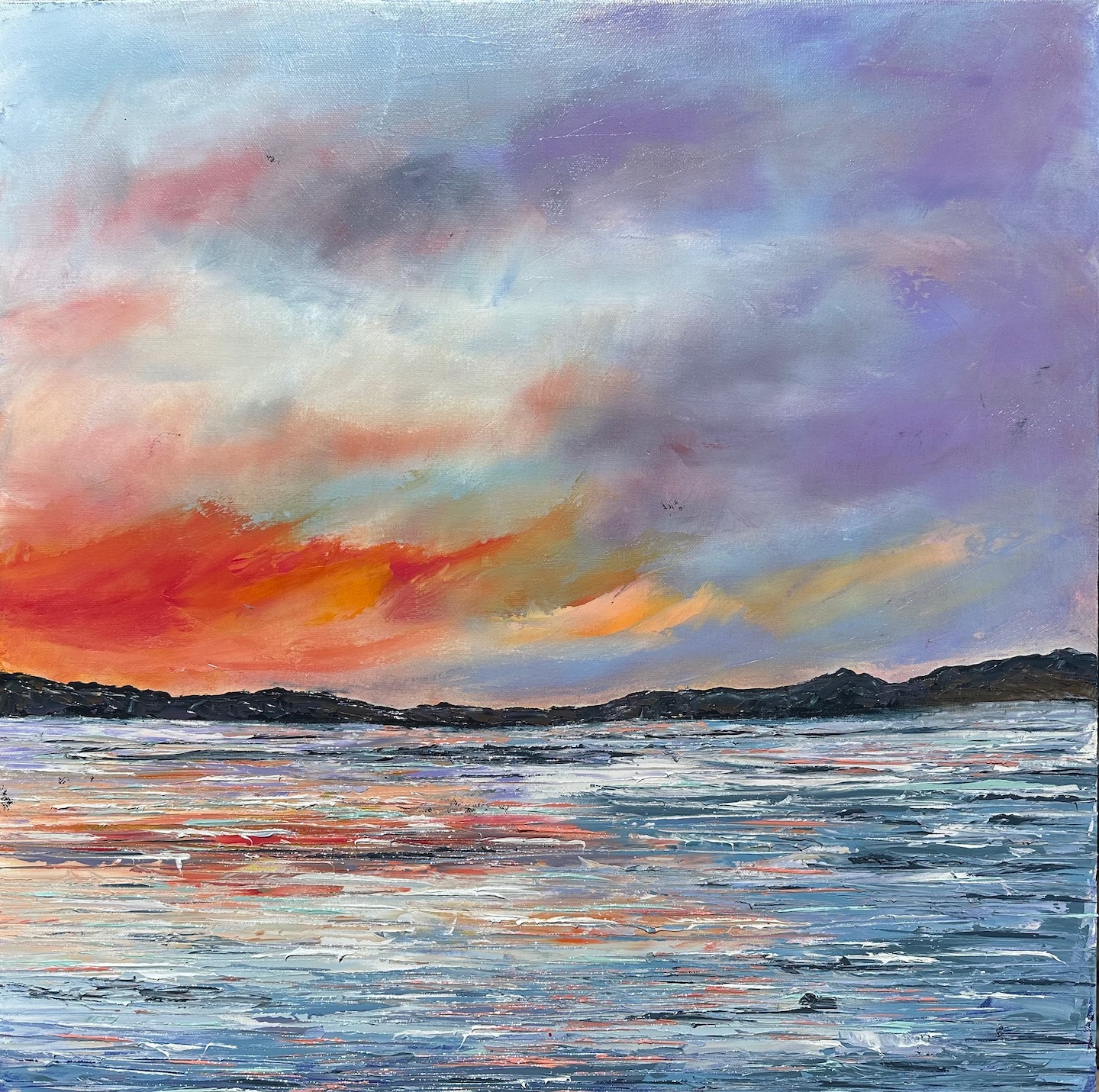
The United Skies of Purple Rain
The rain itself will never be purple. Nor will the sky be – at least not in the moment when the world turns overcast, then darkens into downpour. Overcast days never turned me on. Purple’s emergence will be dependent on the rain’s end and even then, on the right dance between shadow and light.
Of course, images wedded in metaphor need not be real; they need only stir the vast waters of feeling into tangible sense. The best explanation of purple rain as such might come from Prince’s guitarist, Wendy Melvoin. “A new beginning” she stated in a 1984 interview, the same year the Purple Rain film premiered. “Purple, the sky at dawn; rain, the cleansing factor.” It wasn’t the only sky in the Prince soundscape to be overtaken by purple. In an earlier, also titular track to the album 1999, purple sets the song’s apocalyptic scene: “The sky was all purple/There were people runnin’ everywhere.”
Purple, as described in these sung moments, is both beginning and end. The dawn of a new day and its inevitable, immeasurably catastrophic conclusion. Cleansing rain and the skies just before they succumb to smoke.
*
Purple was at first a mystery. I was introduced to Prince by way of the song “1999” in the actual 90’s, back when the year loomed on the future’s horizon.
It was around 1994 and the 1982 song, already considered nostalgic in its datedness, was featured in my dance routine. The studio where I attended dance classes was tucked into the wing of a local racquetball club, two rooms with mirrored walls that cut the world into a vinyl infinity of angles. Our rehearsals were punctuated by the sound of racquet balls bouncing off courts next door, the occasional burst of curse words audible between songs.
“That’s Prince singing,” my dance instructor would tell us, wading through our sea of sequins and leotards as we struggled to hold our wobbly poses.
What I heard was, “That’s the prince singing.”
To me, the song’s vocal pluralities made it a duet and I resolved that both voices, somehow, belonged to the prince. I pictured a giant castle and voices calling to each other from distant, towering turrets. In this corner of my mind, the castle was white. The people singing were also, like me, white. The song’s lyrics, meanwhile, swirled around me in a half-comprehensible haze. A phrase like “Mommy why does everyone have a bomb?” had very little meaning to me, practicing my dance routine to a cassette tape in my bedroom and looking out the window onto the tidy order of a suburban working-class neighborhood.
In the years before 1999, it was possible for much of the world to occupy exclusive space in my imagination, however limited my thinking was. I wouldn’t know that what I heard as a duet was a trio, that the prince was not just Prince, the artist known as and then formerly known as, but an entire musical collective of ages, genders, and races, all under the encompassing umbrella of The Revolution. I wouldn’t know that the elusive, predominately imaginative space in my own brain was a space Prince himself would deliberately occupy: in his insisted distance from the spotlight of celebrity, in his self-christening as a symbol. Prince was something to conceive of, but not to see. Much like the year of 1999, much like the future it then represented.
The song “1999” seemed attuned to how easily the future can shift into nostalgia, how no timeline is impervious to the distortions of projection and memory. Time, too, could blur into a purple continuum.
*
It’s likely that Tipper Gore, wife to then-Senator Al Gore, had about as much awareness of Prince as I once did when, in 1984, she purchased the Purple Rain album for her 11-year-old daughter. By then the title song, featured in the R-rated movie of the same name, was already a massive hit. But it was another song, which ended the album’s first side, that caught Gore’s attention: “I knew a girl named Nikki/Guess (you) could say she was a sex fiend/I met her in a hotel lobby/Masturbating with a magazine.”
The Parents Music Resource Center, subsequently spearheaded by Gore, was formed as its own collective toward Revolution where music was a catalyst for changing the world. Here, though, the goal was to protect children from music’s perceived dangers, and the Parental Advisory sticker, stamped across many an album to come, was the culmination of their efforts. Among the calls for censorship were “topics of fornication, sado-masochism, incest, homosexuality, bestiality and necrophilia.” Among the legislation’s most fierce advocates were right-wing censorship groups.
In the Purple Rain performance of “Darling Nikki” Prince, magnetic, grinds and gyrates onstage in a pantomime that is less sexual than electric burst of performative energy akin to one of his major influences, James Brown – which is still, undoubtedly, sexual. Yet the sex is in service to the music, the song originating from the band’s insistence that the entire Purple Rain album was “too white.” When Prince sings about “a funky time” he is referring as much to the song’s musical roots in funk as he is to its overt gestures toward kink. Thank you for a funky time, call me up whenever you want to grind.
A more extensive listen to “Darling Nikki,” one that lingers past the song’s writhing apex, reveals a larger, ironically – given the aspirations of the Parents Music Resource Center – Christian purpose. But it’s a hidden one, too, the words only legible when played backwards: “Hello, how are you? I’m fine. ‘Cause I know/That the Lord is coming soon, coming, coming soon.” The moment where storm suspends into haze. When light cracks through the clouds, the thunderous display of sexuality, the hunger of fleshly pursuits.
But few were listening beyond that point.
*
In early 2022, a year following the peak and then only slight decline of a pandemic – and with it, racial tensions, contested elections, and attacks on the capitol – I willingly move to a state cast by political discourse as glaring red.
Two weeks into my time as a Florida resident, I am driving at dusk and find myself suddenly submerged in purple light. It takes me a moment to identify the source as the streetlights overhead; light coming from such heights almost eclipses any origin in its totality. Streetlights achieve a kind of invisibility in this way, entering consciousness only in their absence or, in this case, their strangeness.
I start to see purple light everywhere, but also sporadically: the illuminated glow over cars on a highway at night, the random street turned otherworldly. Many of my friends in Florida don’t even notice the purple lights, to the extent that I’d believe them to be a newbie fever dream if it weren’t for the internet’s confirmation in third-rate clickbait articles and reddit threads – corners of the internet that are themselves fever dreams. I learn that streetlights across the south are turning purple due to a defective set of lights originating in a single factory. I learn that the lights now span, in purple bursts, several states and hundreds of miles.
Florida too is a fever dream, with its climbing temperatures and humidity, its lack of seasons that both still time and send hours, days flying by. But it can be a beautiful dream. Daily, I find myself mesmerized by what a flat terrain makes of the sky, the leaping strokes of pink and blue.
“Florida is more purple than you think…” I hear, repeatedly, from the minority of people who want to reassure me of my geographic choices. In fact, Florida was a blue state in the 2008 election, and I lived here then, too, albeit briefly. A recent college graduate, I watched Barack Obama’s inauguration in the break room of my first 9-5 job, employees across the entire hierarchy of departments and roles all erupting into applause.
Now, I return to Florida from a pivotally purple state. In 2020 it was Philadelphia, the city where I lived, that swung Pennsylvania and by extension the entire country from the red of 2016 and into a blue Democratic majority. On November 7, 2020, I drove out of the city to meet up with a friend in New Jersey as “Philadelphia Freedom” blared from every street corner. I then headed toward the countryside, where signs declaring the former president as winner perched proudly, resolutely, on sprawling lawns.
In Florida, these encroaching ideologies are even more apparent, not just as signs along highways but in the strings of laws and pending policies, the Moms for Liberty and the calls for book bans. Acts of legislation are like streetlights: beacons, ingrained in daily life to the point of invisibility, often only noticeable when the light turns a different color or, goes out entirely.
As I continue to make a home of Florida, I find myself actively searching for the purple lights, craving the moment of being washed in surrealism. Over time, the purple lights disappear. The defect becomes obliterated, inevitably, by the dying of the light.
*
Dearly beloved, we are gathered here today to get through this thing called life. Before the invocation, church organs. The spoken opening to “Let’s Go Crazy,” which ignites as well the Purple Rain album and the title film, evokes both wedding and funeral or, more specifically, weds us to our inevitable mortality. “Are we gonna let the elevator bring us down?” Even at the time, Prince spoke candidly about “elevator” as a metaphor for “devil,” and this question of spirituality and temptation could be said to guide the entire album, through the medial storm of “Darling Nikki” and the culminating “Purple Rain.”
Prince isn’t the first to seek a language for the less tangible realm of spirit, and to find that it resides on a purple spectrum.
*
Not less because in purple I descended
The western day through what you called
The loneliest air, not less was I myself
*
Wallace Steven’s 1921 poem “Tea at the Palaz of Hoon” is a solipsistic exploration into psychology and the unconscious within a war-torn environment – toward which orientalism, too, plays no small part, the poem as stepped in a stereotyped conception of the eastern hemisphere as the tea evoked in its title. But in this poem’s searching atmosphere, purple is not just a color and to be “in purple” not just a wardrobe choice, but a more mystical cloak of emotion, a sensation of sweeping from the sky and into the quotidian. The feeling orients only insofar as it disorients, surreal as purple streetlights.
And then, nearly six decades later, come the words of Alice Walker, voiced through her main characters, lovers Celie and Shug Avery. In a scene at the heart of The Color Purple, Shug tells Celie that pausing to admire purple in a field is an act of recognizing the divine in the every day. Purple is among the rarest colors in nature, originating in a tiny sea snail that was used for dye by the Phoenicians in the 16th century BCE. The religious anointing of purple, meanwhile, can be traced back to Jesus himself, donned in purple before the crucifixion.
The color’s rarity makes it a shape-shifter of symbolic meaning. Purple isn’t a clear rise toward something higher, or any straight destination. Purple is holiness amidst wavering descent, the necessity for pause, the violence at the edges; the lure, even, of wayward motion.
Are we gonna let the elevator bring us down? For Prince the question proved tragically prescient, its symbolism harrowingly literal when, on April 21, 2016, a body was reported to be found in an elevator at his residence of Paisley Park. Later identified as Prince, the details followed: an overdose and an opiate addiction that crippled his final years of life and troubled an otherwise sober image.
For many, the end of 2016, the year in which we saw the end of Prince’s worldly Purple Reign, was when the symbolism of our country lurched into a new kind of haze. The Western world, in purple descent.
*
It turned out that the skies didn’t turn purple in 1999. Instead, right around that time, the landscape of the United States became formally divided into red and blue. Although our current color-coded bifurcation of political parties into Republican and Democrat began as early as 1976, the party to which each color belonged varied with the random discretion of television networks. The historically contested 2000 election, and its heated conclusion with the win of George HW Bush, was what solidified not only red as Republican and blue as Democrat but as well, a clear fragmentation of states along those bold classifications.
If Prince stood for anything through the many phases of his career, he stood against division: of gender, politics, genre, race. Like many artists of the Reagan era, he aspired toward something larger than life, transcending not only reality but the very basis of boundary. Or at least he appeared to, which is why white people like me could watch television and be lured into a fantasy of triumph over racism because we saw people like Prince dance across its screen.
A flag unfurling in the wind is red, white, and blue. In a map of the United States, flatlined across television screens as a puzzle of red and blue, the color that becomes most eclipsed is white, even if whiteness above all colors has the power to eclipse entirely. Darkness, meanwhile, is the harrowed ocean that cradles the states. And the states, no matter how much they may flicker between the two primary colors, will never merge into purple.
*
During an involuntary dating hiatus, I say to a friend: “Physically, in terms of what I would want in a man, Prince is it.” Queerness is not yet a full-bodied term for the shape of my own desires, which I never felt could fit into any binary, if they could be said to fit anywhere at all.
“But are there even men like that?” my friend asks. And then, to my silence, she poses another question: “I mean like, walking around in the world?”
Of both questions, I have little answer. The world is making me question just how many people can walk around in it.
“The androgynous mind,” Virginia Woolf writes in A Room of One’s Own, of Samuel Taylor Coleridge, “is resonant and porous; that it transmits emotion without impediment; that it is naturally creative, incandescent and undivided.” Many years later, Prince sang “I’m not a woman, I’m not a man /I am something that you’ll never understand” at the close of Purple Rain and as a nod to a messiah-like inclusivity. In the film’s opening, a procession of faces from the audience penetrates the darkness of the First Avenue nightclub, makeup and glitter flashing brighter than any differentiation between male and female. At the height of his gender-bending, Prince sang passionately of heteronormative sex while wearing knee-high heels as his voice soared into the synthesized falsetto of his alter ego, Camille. Prince’s penchant for rigorous dancing in heels – along with jumping from pianos, stage rafters, the highest ledges he could find – would contribute to his lifetime of chronic pain, which would in turn contribute to the opiate overdose that abruptly ended his life.
Around the time Prince dies, I am in a committed relationship with a man for the first time, or at least what I understand one to be. Donald Trump looms as a presidential candidate. I am considering the norms of marriage as marriage becomes potentially less of a norm for many people. I am considering masculinity, the men who walk around in the world, and I am considering the ways to operate alongside and with them. Norms swarm around me in a storm of primary colors.
I am also finishing my doctoral dissertation on the invention of the English sonnet, a love poem which originated with the medieval Italian poet Francis Petrarch. I am listening to so much Prince that I keep miswriting “Petrarch” as “Prince.” Even for an overly analytical, connection-hungry doctoral student, the mistake seems purposeful: there is some kind of lyric chronology that can accommodate Petrarch, who charted a new form for the language of love, and Prince, who merged the spiritual with the sensual, eventually attempting to transcend the constraints of language by becoming a symbol. Petrarch, meanwhile, popularized in sonnet form the poetic blazon, or the woman as symbol, described in pieces through her physical features.
In this dance of my own ideas, I fail to notice the resonance of “Petrarch” with “patriarchy” from which Prince, too, is not divorced. More recently, a documentary about Prince was halted by his estate for its explorations into the full scope of his character, the relationships with women that verged uncomfortably close to abusive. These tendencies were always apparent to anyone paying close enough attention, in the accounts of Prince’s disproportionately younger lovers, in Purple Rain’s moments of misogyny – few can forget the woman in a trash can, or the flashes of domestic violence– even if they shared the same screen as the unabashed displays of power from not-so-covert partners Wendy and Lisa, whose testimonies of Prince supporting women have always been shadowed by the obsessive degree to which he sought to control them.
*
I visit Paisley Park for the first time in October of 2016, almost exactly six months after Prince’s passing. I am staying on the outskirts of Minneapolis, which is home to my good friend, Janet. Colors are turning for the season, the air chilled in a way that I will, years later, come to miss as a Florida resident.
The large white castle I had originally envisaged in the song “1999” is not, I realize as Janet and I pull up to Paisley Park, entirely wrong. Nor was my conception of lone voices calling to each other across a vast chasm. Paisley Park is a large, industrial structure at the edge of a busy highway, visible but also noticeably isolated behind a chain link fence. While dropping me off for my tour, Janet confesses she had mistaken the entire complex for new-age church until now.
The experience of being inside Paisley Park’s walls is a similar mix of awe-inspiring and alienating. The interior, a purple heart to the new-age castle, is dated at best. The purple plush of the love seats is fading, worn more from abandonment than regular use. I observe the thick layer of dust on the untouched kitchen appliances. Even with the rapidly quick turnaround from residence to museum, it feels impossible to imagine anyone living here less than six months ago. The actual living quarters located upstairs are blocked off, not only to preserve privacy but also to keep visitors from the location where Prince died, alone and tragically. Years later, I will note an eerily similar setup at Elvis Presley’s Graceland.
While driving to Paisley Park, Mall of America, and festive hayrides on Minnesota farms, Janet and I are discussing the upcoming election.
“He will win, Jenny,” she says, turning to face me from the steering wheel of her car. In the window behind her, the autumnal foliage blurs into a burst of fiery orange.
“He won’t,” I reply. “He can’t.” I observe how a tree’s leaves are brightest, most beautiful, just before gravity inevitably returns them to the earth.
I post photos of us on social media, adults frolicking in a corn field, then update my Facebook profile with the Hillary Clinton campaign’s watermark “H,” where the letter becomes an arrow pointing toward progressive solidarity with “her.” Facebook is erupting with groups like Pantsuit Nation, ready to celebrate the first female president. I ignore contradictory posts from distant family members. The world feels ready to welcome us, ready for this increasingly inclusive party – until, we all soon discover, it isn’t.
*
Now, in the aftermath of another election, I read 2016 as a sonnet and I attempt to follow its symbolic threads, the turns and repetitions. Was it a coincidence that the earliest days of 2016 were marked by the death of gender-bending iconoclast David Bowie, that Prince left in April closer to the mid-way point of the same year? Could it be said that Prince’s death signified a final burst of purple before the world bruised into a deeper fragmentation of red and blue?
The loss of major artists continued right up until Election Day. On November 7, 2016, Leonard Cohen died of what was described as natural causes, inextricable from the injuries he sustained adhering to a massive tour scheduled to pay off his debts. You Want It Darker was the title of his final album and single. Released before his death, it resurged in the days following, when the darkness no longer required summoning.
There were earlier shocks to the collective system, too, more penetrating than any celebrity death: the racist murders, a June shooting at a gay nightclub in Orlando, Florida. A rainbow giving way to a darkening sky. Party over, oops, out of time.
The Shakespearean sonnet, which the Petrarchan sonnet would eventually more famously become, is distinguished by final lines that introduce a new rhyme scheme, a concluding couplet that serves as the poem’s final, starkest repetition. At this point my sonnet comes to include not just the year of 2016 but larger points in time: 2016 and the present, the present and 1984, future 1999 and nostalgic 1999. Across these years are other rhymes: Democrat and Republican, Making America Great and Make America Great Again, Parents Music Resource Center and Moms for Liberty, Form and Reform, Reform and Freedom.
A sonnet, like most poetic forms, speaks to the mind’s desire for pattern, the need to find meaning in confusion and chaos. It is defined as well by what comes after, which is blank space.
*
Since Prince wrote the song “1999,” popular culture has become less preoccupied with projecting into the future, whether it be a crumbling dystopia or buzzing with gadgets and possibility. In a world already overtaken by technology, where the landscape of dystopia is achingly familiar, manufactured nostalgia reigns supreme.
Apocalypse, the final catastrophe, will always exist only in language because it is by definition distant, dwelling in future and mystery. But maybe apocalypse is no longer sufficient description for what descends upon us. Maybe the apocalypse is gradual, barely noticeable in its approach. Maybe it will manifest not in the sky but in what whatever prevents us from gazing up, the downward scroll of digital oblivion, an ending so vapid it is devoid of symbolism. Maybe the skies will not be purple but full of flood and natural disaster.
Colors and symbols are approximations, offering both irresistible hope and inevitable limitation. At best they unify into something singularly inspiring. At worst they can be constricting, divisive, diminishing what lives and breathes.
Parties weren’t meant to last. A nation’s struggles and expansive skies, stitched into a precarious fabric of red, white, and blue. An artist that would, many years later, weave these colors into a new kind revolution. Years later still, that same artist collapsing as a country unraveled under its own promise and pain. And purple, the color at the cusp, the mountains that hint at distant majesty. Purple the beginning and the end, the beauty and despair. Purple, finally, in the yearning. The color of the future and of the just before. Before the darkness becomes dawn, before dawn becomes light.
Purple, before it all fades away.
Author Jenny Boyar’s (she/her) poetry has been published with Maudlin House, Panorama, FEED lit mag, and elsewhere, and her essays have appeared in the Los Angeles Review of Books and other scholarly publications. A Fulbright recipient, she holds a PhD from the University of Rochester. She works as a medical writer and lives in St. Petersburg, Florida. You can follow her on Instagram @jennyboyar.
Artist Chelsea Tikotsky’s (she/her) paintings explore the interplay between forest and field—a metaphor for finding clarity, peace, and light through moments of stillness. Her work moves between landscapes, evoking the quiet mystery of the woods, and florals, reflecting the openness of the fields. Together, they invite viewers to pause, notice, and embrace the fleeting magic in everyday life. Based in the San Francisco Bay Area, Tikotsky holds a B.A. in Studio Art from San Francisco State University and refined her perspective at the Accademia di Belle Arti in Florence, Italy. Her work has been showcased across the U.S., including the 2024 PBS KVIE Art Auction (Juror’s Award), and featured in Visionary Art Collective (VAC) and Apricity Magazine (Volume 9, 2025). Her paintings are held in private collections both in the United States and abroad. You can follow her on Instagram @chelseatikotskyart.
 Gulf Stream Magazine