
by Anna Swann-Pye
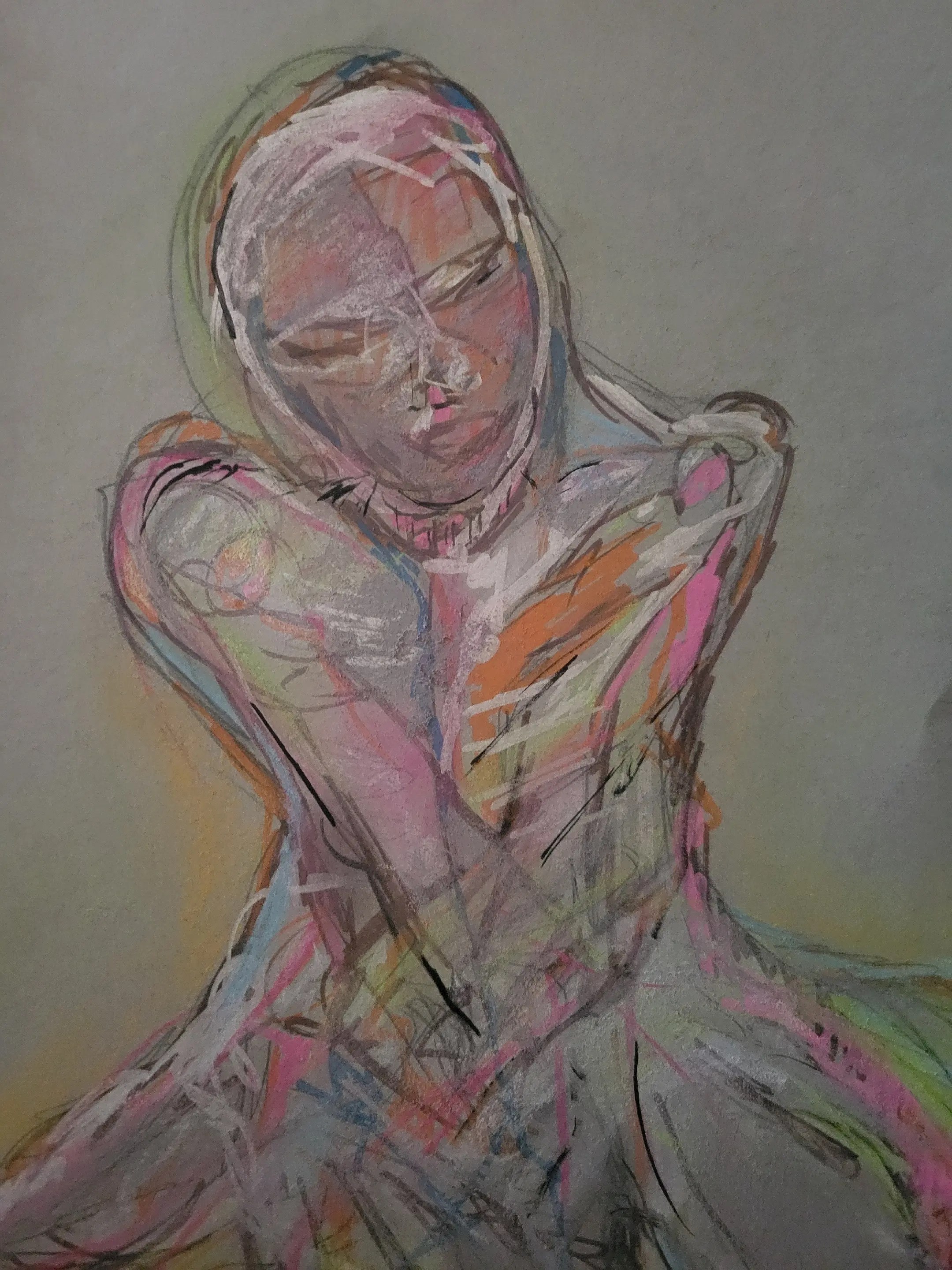
Ladies Lazari
Two months ago, I wrote an essay about the death of my dog and subsequent loss of a pregnancy. I compared forms of grief, thought about god and death, and sent it around to my loved ones and a couple literary magazines for good measure.
The Board of Editors at a journal in the midwest told me they “admired the short piece” but wished “there was more self-awareness of the melodrama in it.” Or, as they called it, “the extreme response to loss of pet.”
This baffled me. I scanned the essay for possible moments of extremity. Sure, I compared my dead dog to Emerson’s dead son. And, yes, I suggested a sort of death-by-grenade scenario—a suicide pact with my terminal mutt. But of course I did! Why approach grief with nuance when you can blow it all up instead? I drafted multiple iterations of the same rebuttal in my head:
“Dear Editors: Can’t you see I’m well aware of the show I put on?”
______________
At five, I dressed in my babysitter’s hand-me-down homecoming dresses and performed repetitions of the national anthem in front of a jury of my dad. Each time I instructed him to give me three pieces of positive feedback and a score between 9.5 and 10.
“The flourish on the ‘bombs bursting’ line really moved me.
I was struck by your consistent curtseying, you looked like an elegant horse.
Very nice hairdo.
9.6.”
That same year my first-grade teacher told my parents I struggled to focus during story time—that I stood in the corner of the room and enacted my own drama as she read. She found it difficult to keep the other kids focused while I cast my interior life onto the screen.
______________
In school last week we read Lady Lazarus and discussed death as spectacle. In the poem, Plath enacts death by suicide again and again. “I know we’re not supposed to say this,” my student admitted, “but I feel like she is kind of into it. Like, why’d she have to die so many times? Or compare herself to a Jew in a death camp? It’s weird.” The melodrama is not lost on them.
We talk about figurative language and concretizing the abstract. I tell them metaphors are often brazen—used when the language of nuance will no longer suffice. They’re flamboyant, bursting at the seams, overly dramatic, at times. At times, perhaps, wholly inappropriate. But she’s made us look, hasn’t she?
“To write is to rave a little bit,” Elizabeth Bowen says. Bowen’s women journal, the raving internalized. Plath, on the other hand, splatters the screen—her associations are beyond the pale and bright as a Nazi lampshade. What a problem she has always been.
______________
When I was a sophomore in high school, I used to fantasize that my friends would visit me comatose in a hospital bed. “We’re so sorry, Anna,” I imagine they’d say, “We wish we’d been more aware of your many talents when you were around.” It was the closest I’d get to Huck at his own funeral—me, hooked to monitors and half-dressed, in this fantasy.Them, the peanut crunching crowd, in awe of my body etherized on the table, displayed in all its splendor. My therapist suggested this fantasy likely had to do with my fear of abandonment. My guess it was more related to my finally developed breasts. I struggle with zoom therapy because I spend the hour staring at my own face.
Plath doesn’t care about dying, I want to tell these students. She cares about the presentation of her hands and knees—the big strip tease. Dying, it seems, may be just a necessary pit stop en route to the pretty body on the bed. I think about Kim Kardashian’s coffee table book of selfies: melodrama as art.
______________
Three months ago, the pregnancy I thought might be a baby turned out to be a bust. “Too much brain and not enough skull,” the doctor said. Prefrontal cortex too large for containment. Trigeminal nerve too in the ether. The metaphor bursts at the seams.
On the day of the abortion I wore my most flattering sweatpants and sat in a hospital bed surrounded by other people in hospital beds. “I saw a man’s naked butt,” I told my husband on our drive home. “The woman next to me lied about her last Ozempic shot and they found her out.” Four men on the anesthetist’s team touched my knees and the head doctor told me when I woke up that I bled profusely. “That was more of a problem for me than it was for you,” he said. I felt the imagined blood pooling inside my stomach, arm still hooked to IV—formulated, sprawling on a pin. I’m sorry to be such a problem, I think to say. I’ve only ever wanted to entertain. I try to recover my good image by making a joke about the hospital biscuits: it’s the theatrical come back in broad day.
______________
The morning after we read “Lady Lazarus,” my student came into the room sobbing. “I thought I could handle that poem,” she said, “but I was raped last year and everyone knows it. I could feel them staring at me.” I give her candy and sit with her for an hour. I tell her that nobody was staring but, of course, I’m not sure. I think about my friend, Charlotte, whose naked photos were projected onto the board in 10th grade as a prank—the sickest magic lantern; the sickest bedroom.
Everyone has pictured Plath’s head in the oven at least once.
______________
In college, I went to a modern dance performance and a girl in a bright orange leotard writhed to Fergie for her senior show. “Well, that was all hips and no nuance,” my boyfriend, Gabe, laughed. The peanut crunching crowd. I loved every moment of her gyrating hips. I stared at her bulging tendons and felt the flexing of my butt in the seat.
The day before three boys in my writing class tore my poem apart—the relationship to the father figure is too laid bare—and Gabe asked me to have a threesome because “a single body, over time, becomes dull.”
That same year Emma Sulkowicz carried a mattress across Columbia campus after the school found her rapist, Paul Nungesser, ‘not responsible.’ Gabe said he empathized with the message but the metaphor was “a little clunky.” It weighed 45 pounds to be exact. I saw her on the train once with the mattress and imagined telling her the act seemed just brazen enough. “Once you compare your suffering to the Holocaust,” my professor said of Lady Lazarus, “you’ve rendered any other metaphor obsolete.”
______________
“We’re finishing the poem tomorrow,” I tell my crying student. “I want you there but understand if you’d rather not sit through it again.”
What I want to tell her is that when I was four, I threw a tantrum in a Pizza Hut. “It’s my body,” I screamed, as my mom tried to extricate me from the salad bar. I writhed and gyrated on the floor.
It’s my body, don’t harm me.
It’s my body, let me dance.
It’s my body, watch me dance.
What I want to tell her is that Plath struggled to get The Bell Jar published—Alfred Knopf of The New York Times felt that, with the breakdown of the narrator, “the story ceased to be a novel and became a case history.” The relationship to the father figure was too laid bare.
What I want to tell her is to enact the drama on the screen—give them what they think they’re taking. It’s more of a problem for them than it is for you. I hug her and watch her leave.
______________
“I think,” another student said, “the line ‘there is a charge for the eyeing of my scars’ either implies that we have to pay to view Plath’s misery or that she’s electrified.” The analysis seems a little imprecise and just brazen enough.
I imagine the poet alight in the classroom.
She writhes; electrical currents in a shift dress.
(out of the ash/I rise with my red hair/and I eat men like air)
What a show, what a phoenix, what a problem she’s always been.
_______________
“What a performance” I imagine my dad, the judge, exclaim. “But the metaphor’s a little clunky, don’t you think?”
“A little melodramatic,” the panel agrees, don’t you think?
“All hips and no nuance,” echoes the peanut crunching crowd, don’t you think?
“ 9.6.”
Author Anna Swann-Pye studied English and Writing at Bard College and has taught twelfth-grade English for the last ten years. She loves to write and has derived immense joy from teaching great writers. Now she is interested in contributing her own work. Her first essay, “Dog Complex”, is being published in Meridian Magazine (UVA) in May.
Artist Shannon George is a former teacher turned librarian with a deep passion for art and creativity. Her work, primarily focused on the exploration of movement and form, often captures the fluidity and grace of the human body. Her soft pastel pieces have been published or are forthcoming fromWhispers and Roars and Beyond Words Magazine. Shannon enjoys experimenting with new mediums, finding joy in the process of discovery and self-expression. Outside of her art, she cherishes quiet moments with her beloved Goldendoodle, Bella, and finds inspiration in poetry.
 Gulf Stream Magazine