
by Jacob Griffin Hall
I Miss You Thank You for Being Here
1.
Inside every place is a vast reservoir of feeling. Inside every person, too.
Sometimes, when my mood is right, I can feel the reservoirs mixing. The currents touch each other and stir. I feel them in my stomach, outside of my body, drifting around the room. Do you feel them too?
The first chivo I went to in San José was downtown, in 2022. We brought masks. It was supposed to be at a bar that, we realized arriving to the shuttered and graffitied façade, no longer existed. We only kind of knew one person, so we messaged her and paced and argued.
It was a hardcore punk show. I was overdressed for the heat and sweating. Turns out the bar had reopened, but in a different spot, which was news to us. We found our way there with our still piecemealed Spanish and stood in the back as Ladrona took the stage, and we watched as Valex, the vocalist, called for a pit without men, women and femmes to the front, and Katie looked at me and grinned, and we felt the doors to our reservoirs open and we felt the currents purl and stagger.
2.
I live with two contradictory instincts: to change, and not to change. I imagine this is a common irony. I’ve never imagined myself exceptional.
Though, I guess I have imagined myself exceptional, too. Haven’t you?
3.
Arriving at the venue, I felt distinctly aware of my body. I could feel each fold of my jeans caressing my legs, from crotch to ankle. My shirt stuck to my skin under my jacket. I’d been smoking too much, and I was excited, so my chest felt heavy, my breathing slightly labored. I also felt distinctly aware that I was stepping into a space from the outside.
We stood at the gate for a while and smoked and hung out and talked with some kids in battle jackets. They told us a little about one of the bands we didn’t know. One of them bummed a cigarette.
I can’t help but feel lucky that fentanyl wasn’t in the mix when I was a teenager, I end up telling the kid who bummed a smoke, and he tells me that it hasn’t been much in the mix here, either, which is lucky. It means that when I tell him a few stories about our scene now in the States, the sadness is a little different. I mention the dead friends and it’s a little different. But it’s mostly the same. There’s plenty to kill you no matter where you are. We both know it. None of us imagine ourselves exceptional, except when we do.
4.
Standing outside talking with folks about a scene that is different, but also the same, exceptional and not, I can’t help but be mindful of the way that language shapes all of this—me, the scene, one’s fit in the puzzle of a moment in time. I run out of language and switch back to English in my mind.
5.
I think it’s the feeling of language that intrigues me most. How it feels, using language, to reach. How, reaching, you sometimes brush up against the between-things of it all. How it feels to catch a glimpse of the overlap, the mingled boundary between language and everything it shapes. You reach and are inside the palimpsest, the mess of intent and referent and neurotransmitters and noumena. I like feeling how language moves inside of it all. I like feeling language move through me.
I like the feeling of music, too.
6.
There’s a weird kind of relief that sets in when the band starts and the possibility of conversation disappears. It’s like a burden being lifted, even if you were enjoying the conversation, or even if there wasn’t any conversation happening. When the band starts, something in the weight of the room shifts. The shape of language changes. The music redesigns the event between people. This phenomenon was one of the first things I loved about live music—I loved how it felt to step in and out of the trance of it, to be held by it. Sometimes music feels like language. Sometimes it is language.
7.
After Ladrona, we finally met up with the one person we kind of knew. We sat together in the grass out front of the building and accidentally talked through the last band’s whole set. Our new friend wanted to get out of the city. She wanted to stay in the city, too. How many contradictions live inside of you? We talked for hours, and then for years. We set to work shaping the language of us.
When you touch something new, a person or a song or a feeling or a language, anything, it can feel like up until that point, nothing has really mattered. It’s a fleeting feeling, of course, because everything matters, and nothing matters, and both things are so obvious as to be unremarkable. But when you come to touch something new and open yourself to it and feel the possibility that it could open to you, it can feel as if some astounding oversight is revealed. It’s as if the world is widening right in front of you.
8.
After that first show, we caught a ride home and went up to the roof to look at the city. Standing at the railing, the steady thrum of music still heavy in my body, I gazed out over the miles of burnt umber slats, metal rooftops, the streets between them streaked with headlights all the way from San José to Alajuela. I watched the clouds drift slowly over the mountain peaks, moving easy, like pedestrians lolling up the sidewalk at night after the bars let out, no hurry to settle down anywhere in particular. The whole valley, held there in front of us, and holding us. A vast reservoir of feeling.
Author Jacob Griffin Hall was raised outside of Atlanta, GA and lives in Columbia, MO, where he teaches English at the University of Missouri. His first collection of poetry, Burial Machine, won the 2021 Backlash Best Book Award and is available with Backlash Press. Jacob’s writing has appeared in the Missouri Review, 32 Poems, New Ohio Review, Black Warrior Review, New Orleans Review, Southern Humanities Review, and elsewhere.
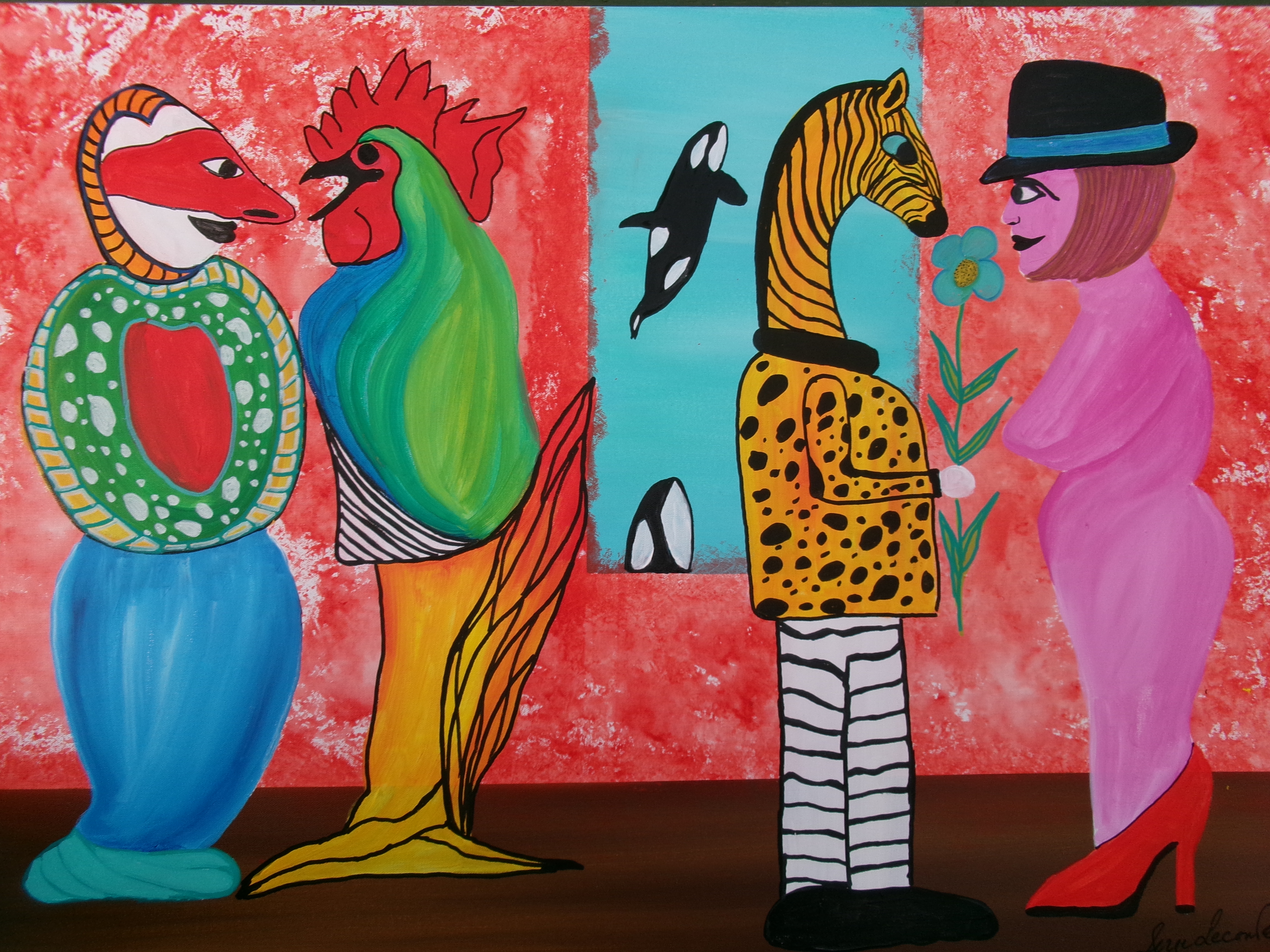
Artist Serge Lecomte was born in Belgium in 1946. He came to the States where he spent his teens in South Philly and then Brooklyn. After graduating from Tilden H. S. he joined the Medical Corps in the Air Force. He earned an MA and Ph.D. from Vanderbilt University in Russian Literature with a minor in French Literature. He worked as a Green Beret language instructor at Fort Bragg, NC from 1975-78. In 1988 he received a B.A. from the University of Alaska Fairbanks in Spanish Literature. He worked as a language teacher at the University of Alaska (1978-1997). He worked as a house builder, pipe-fitter, orderly in a hospital, gardener, landscaper, driller for an assaying company, bartender and painter.
 Gulf Stream Magazine