
by Michele Alouf
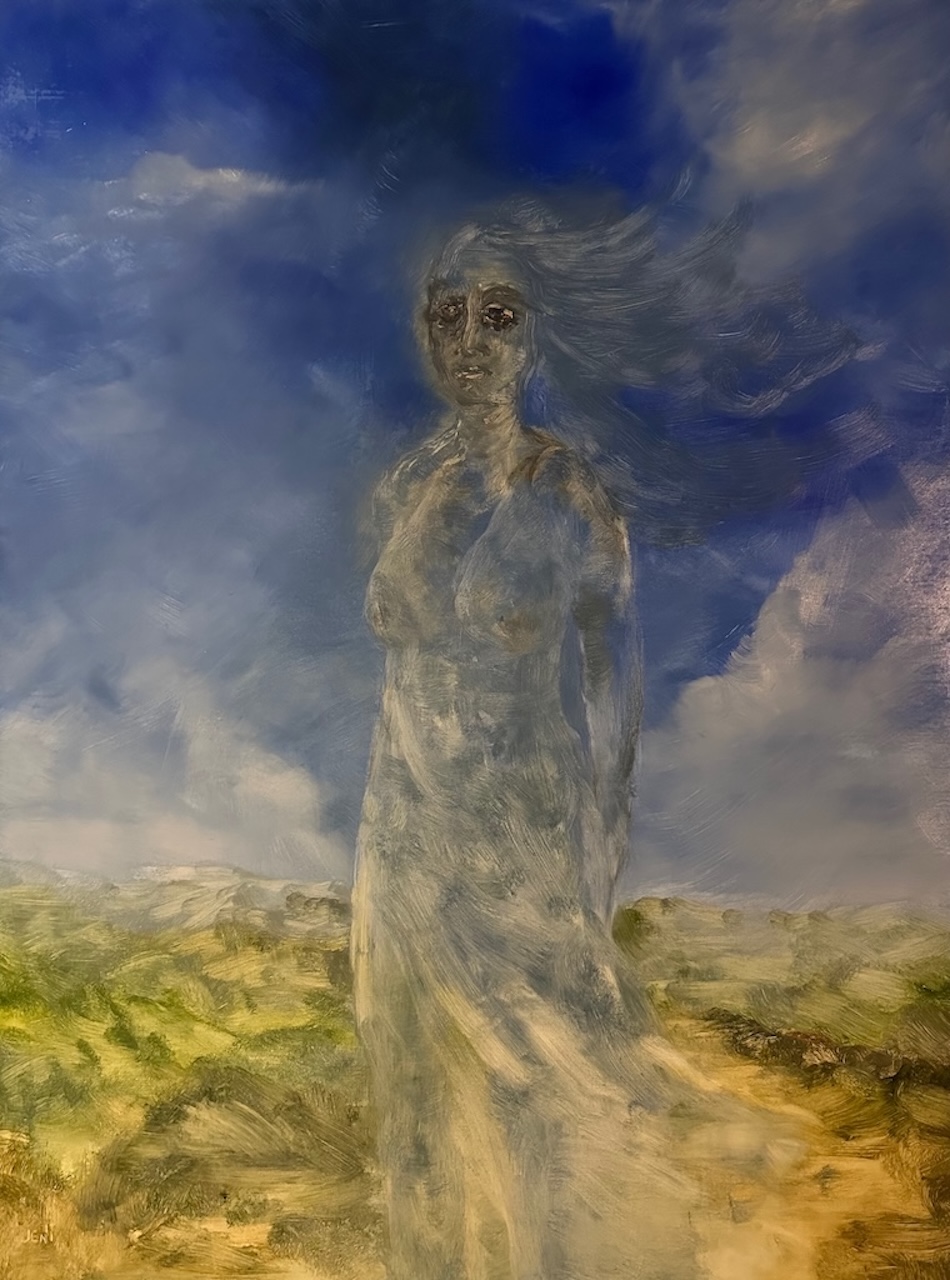
Ghosting
As a child, I sang Paul Simon’s “50 Ways to Leave Your Lover” with my mom and brothers as we drove home in her canary-yellow Cordoba from an afternoon of Christmas shopping at Sarasota Square Mall. Most likely, it was a balmy Florida day, early in December, around the mid-seventies (both in time and temperature). We probably should have been in classrooms with chalk-covered nuns, but my mother had a habit of checking us out of St. Martha’s Catholic School early, whispering, “the Pope declared it a holiday.” Like Simon’s lyrical disciples, out-the-back Jack, new-plan Stan, not-so-coy Roy, and bus-hopping Gus, we were set free.
At the time, all I knew of love and loss was what I learned from the Christmas cartoon girl, Karen, crying over a puddle with a corncob pipe and a button nose that had been her friend, Frosty. At least he had the common decency to melt slowly. Snowmen are considerate that way. Also, much like Jesus, he miraculously returned, but you can’t always count on people coming back, Jack. It’s a lesson Christmas specials and Sunday schools sacrifice for an early childhood curriculum of happy endings. Interestingly, “50 Ways to Leave Your Lover” was Simon’s first number-one hit after divorcing his wife and deserting Art Garfunkel for a solo career. I’m not saying he ghosted either of them, but his little ditty on shady ditching provides a valuable prototype for the more modern artful dodger.
In its truest sense, ghosting is an intentional act of abandonment. Victims of evil magicians and Pontius Pilate need not apply. The motivations of more mysteriously disappearing persons are harder to gauge. Take, for example, Amelia Earhart. For years, I held her personally responsible for several of my irrational fears and romantic failures. In elementary school, I was one of two winners of a school essay contest with a terrifying “prize.” Addressing the topic, “What I Want to be When I Grow Up,” I wrote with all the passion a ten-year-old can muster about becoming a writer. I said nothing about being a pilot. The authors of the top two essays won a trip in a prop plane around our Florida town, over the Gulf of Mexico, and above its shadowy sharks. It was 1977ish, and thanks to Amelia, I was terrified of planes, Jaws, Japanese prisoner camps, the Bermuda Triangle, aliens, and the cute boy with the other winning essay. (So, maybe it’s not fair to blame Amelia for that last one, but it’s really hard to be cool in front of the opposite sex when you’re about to die with burgeoning Catholic guilt and a spot of pee in your pants.)
I survived the flight, but my litany of childhood fears grew into an all-encompassing one of being out of control not only in a plane but in relationships doomed to crash or vanish in thin air. Amelia Earhart, I can forgive, but only if she meant to return. Her husband might have argued that she ghosted him based on her prenuptial letter establishing loose boundaries lest their marriage became a cage. If that is the case, she deserves the prize for the all-time greatest act of ghosting.
The verb form of the word ghost poetically suggests a smooth exit that has the power to haunt, not with a lingering presence but with the black hole of absence. It’s a mysterious, sexy term if getting mercilessly dumped, eighty-sixed, and deserted can be called sexy. I prefer the less elusive noun form of the word, the kind of ghosts that hang around and have the courtesy to haunt you in person.
There was a time when I, undeterred by an axe-wielding Jack Nicholson in The Shining, wanted to believe in ghosts of the noun variety. I was in my early teens, and an uncle I had never met on my Italian mother’s side came to visit us in Sarasota shortly after his wife of several decades had passed away. I think that his name was Uncle Johnny Pepe. I’m pretty sure I didn’t fabricate a name like that for a sad-sack septuagenarian because the only irony that struck me at the time was being legitimately absent from school with mono before my first kiss.
As my mom busied about her weekdays, I spent a lot of Price-is-Right passing hours alone with Uncle Not-So-Pepe. The man, wearing a uniform of undershirts and dress pants like he had somewhere to be but wasn’t quite ready, didn’t talk much from his side of our plaid couch. Occasionally, he might shout “bid a dollar” at a contestant eying an upright Hoover, but he mostly mumbled “Oh, Madone” while lifting his eyes to the ceiling. We found a little common ground one day watching General Hospital. His late wife, Stella, loved her “stories,” and General Hospital was her favorite. As a Luke and Laura aficionado, I was able to brief Uncle Johnny on the happenings of Port Charles since Stella’s death. He was a captive audience, pepped up by the intel he could share with his Stella “when she comes to visit” that night.
The opposite of ghosting has to be a dead spouse offering turn-down service. According to Uncle Johnny, Stella checked in at the end of each day to see how he was getting along and tell him about her day in Heaven. Curious, I stayed up one night to listen to the spectral happenings across the hall from my bedroom. I could hear Uncle Johnny’s end of a conversation. On my mother’s cooking: “Manicotti’s good, but nothing like yours.” On my mono: “That one, she should stop kissing the boys.” On Stella’s “stories”: “You tell me how these soapbox opera guys keep coming back from the dead.” Stella stayed silent. Needing to know if she was really in there, I got out of bed and crossed the hall. I imagined I’d see him in his undershirt, gesticulating to a glowing apparition in a white gown. Though I knew the working-class status of the Pepe family, I somehow expected eternal Stella to look like a fur-wrapped Eva Gabor from Green Acres. Cracking the door, I saw nothing but Uncle Johnny, alone and twisting in the sheets.
My first major heartbreak, which future me would reclassify as a hairline fracture, had a lot to do with my embedded Amelia-Earhart fears and Lionel Richie songs promising endless, superglue-quality love. A beautiful boy I knew through high school professed his longing for me in spastic gestures gleaned from eighties coming-of-age films, but he never asked me out. When he learned I wanted to take him to a Sadie Hawkins dance, he took to hiding behind trees. Eventually, we ended up dating off and on in college during a reckless, self-destructive stage of my life before my sense of self-worth and therapy kicked in. At one particularly low point, he offered to pull me from the muck and mire and love me forever. Just as I found firmer footing, he ghosted me or tried giving it his best pre-cellphone-era shot. Attending schools in different states facilitated his vanishing act, but I had some dignity to spare before I let him “hop on the bus, Gus.” I called his dorm incessantly, racking up my parents’ long-distance bill. I interrogated his poor roommate, who I had never met but respected for his valiant efforts to lie between stuttering uh’s. Eventually, my forever-love relented and answered the phone to basically tell me to “hit the road, Jack.”
Despite the emotional pain and debt owed to my parents (per-minute humiliation rates were high back then), I’m glad I heard him say, “I don’t love you.” If I’d let him ghost me, I’d always wonder if he’d reappear like a dead soap star or my own personal Jesus, who, at the time, I, along with Depeche Mode, believed another human could be.
My first real major heartbreak was on April 29, 1991, when my mother died. She was forty-seven years old and left without warning. Her life, plagued by mental illness, self-medication, and discontent, ended with an accident, the kind that was always waiting to happen. She sometimes said she wanted to die, somehow vanish, and never return. I often wondered how much effort she put into staying alive. The motivations of more mysteriously disappearing persons are harder to gauge.
“At least she went quickly” was the damnedest thing people said when she passed, and I thought about that for many years after. Questions about death that typically make for party-game fodder haunted me: Would you rather die suddenly or slowly but have time to say goodbye? Would you rather die painlessly alone or in agony surrounded by loved ones? Would you rather know when you are going to die or be surprised? I’d wished I’d played Would You Rather with my mother before she died without saying goodbye, without helping me bustle my wedding gown, and without telling me how much weight she gained during her pregnancies. Whether she intended to or not, she ghosted me and never came back.
I have a recurring dream where my mother returns. I accidentally run into her in a grocery store or Target, and she tells me unapologetically that she faked her death to escape her life, run away, and ghost the hell out of me. My therapist says that I’m everyone in my dreams. That doesn’t make things any clearer. I need a better counselor.
Besides his show-stopping resurrection, the Son of God has some cool tricks. I had the good fortune to get to know him better beyond the walls of the Catholic church, and one-on-one, he’s the guy Depeche Mode should have been singing about. Jesus has a talent for teaching with digressions, recurring themes, and circling back in ways that lead you to truths about life and death without locking you in a hot greenhouse just to get his magic hat back. He has a good reason if he corners you with a dying friend.
Would you rather die suddenly or slowly and have time to say goodbye?
Gail was a neighbor during my boys’ bus-stop years. Her adopted son, Dillon, played with my younger son, and she and I had friendly chats while waiting for the kids to come home from elementary school. Though we had much in common, both former teachers, boy moms, and suffering from true obsessive-compulsive disorder (not the cute label pirated by neat freaks), we never got close. When she was diagnosed with terminal cancer, I was surprised when she handpicked me as one of her helpers. During Gail’s months of treatment and slow deterioration, I had the honor of assisting her and her husband, Bob, as they prepared for her death. I’m still not sure I was the best choice but ghosting them wasn’t an option.
Would you rather die painlessly alone or in agony surrounded by loved ones?
I always wished my mother had written me more letters. When I read the few I have, I still hear her voice over thirty years after her last breath. I, along with some other well-intended friends, encouraged my dying friend, Gail, to write Dillon cards and letters for his father to give him on future birthdays, graduations, and his wedding day. We encouraged her to write a journal of advice and affirmations to guide him in the coming years. I thought of Dillon and how he needed all the things my mother had never left for me. In my vicarious pursuits, I neglected to think how hard these tasks might be for Gail.
Would you rather know when you are going to die or be surprised?
Soon after her last Christmas, Gail was in hospice care, and Bob asked me to go to their house and take down their Christmas tree to help keep things at home organized and as normal as possible. Packing away another family’s Christmas ornaments is an oddly intimate job, handling their memories of Our First Christmas, Dillon’s First Christmas, school years in baubles of yarn and popsicle sticks, and travels in globes of German-blown glass. Each one told me a story about Gail and her family that I had never taken the time to hear directly from her. Alone in her living room, I laughed at a hideous Styrofoam snowman hidden in the back of the tree and cried as I unhooked an ornament from their last family trip to Alaska that hung front and center. Carefully wrapping each one to place in a red Rubbermaid bin, I thought of comparable ornaments from my own childhood, many of which I still have with names and years written on them in my mother’s handwriting: Eddie 1963, Michele 1966, Robbie 1969, and so on. Each Christmas, she bought us new ornaments and labeled them with our names and the year until she ran out of years. I continue this tradition with my children, each Christmas seeking out ornaments that are meaningful to them in the current season. Nicky 2005 is a Curious George dangling precariously from a hook; Nicky 2018 is a hand-painted James Madison University ball. Though after-Christmas sales are tempting, I never think of buying them ornaments for the following year. How could I predict their future likes and needs?
When it came time to close the bin on Gail’s Christmas past, I found a Sharpie and labeled the lid Christmas Ornaments, Handle with Care.
Zoloft is no match for sleep deprivation and rogue post-partum hormones, so my OCD ran amok with the birth of my first child. My internet-fueled obsession with sudden infant death syndrome caused me to hover over my baby’s crib deep into the night. The compulsion to check on someone’s breathing was nothing new, though. As a babysitting young teen, instead of watching The Love Boat, I kept vigil over sleeping toddlers watching the rise and fall of their chests until their parents returned. There were nights I repeatedly checked that each member of my family was breathing until I fell asleep exhausted. Once, as I lingered over my mother’s bed, she woke startled and screamed like she’d seen a ghost. “What is wrong with you?” she asked. I had no idea. My OCD went undiagnosed until I was in my late twenties. People didn’t talk much about mental illness back then, so I apologized for scaring her half to death, kissed her goodnight, and promised to try to “get ahold of myself.” What are the odds, anyway, that I would have been there to save her at the exact moment she stopped breathing?
Toward the end of Gail’s life, I spent a few hours with her in her hospice room. Dillon was in school, and Bob had to meet with a funeral director. Though I planned to read to her from a devotional, she was peacefully sleeping when I got to her bedside. I spent the entire time there holding her hand and watching her breathe. I counted her inhales and wasn’t terrified she’d run out of them, just thankful to witness each one. Was my Zoloft working? Maybe, but I’d like to think I’d finally realized that I have no say in how or when people leave me.
When my youngest was a freshman in high school, I was driving him home from baseball practice on an unseasonably warm December evening in Virginia. Simultaneously rolling down the passenger side window and cranking up the car radio volume, my son announced, “Mom, when I imagine you dying, this is your perfect swan song. I’m going to play it at your funeral.”
As he sang along with Train’s Drops of Jupiter, I was both touched and a little disturbed that he daydreamed about my death, and it has a theme song. I didn’t ask my son, but I wondered how he had me dying. Was there a drawn-out, tearful goodbye scene, or did I ghost him? How, if I had allowed myself, would I have imagined my own mother dying, and who, if not Paul Simon, would sing her perfect swan song?
Author Michele Alouf lives in Richmond, Virginia and is a master’s degree candidate in creative writing at Harvard Extension School. She’s a founder of the writers’ collective Story Street Writers. Her stories are in Bridge Eight, Drunk Monkeys, the Wordrunner e-Chapbook Fiction Anthology–Salvaged, Grim & Gilded, and Sad Girl Diaries.
Artist Jeni Follman is a dynamic fine artist with a passion for expanding the limit of creative expression. Adept at thought-provoking and emotionally engaging works across a wide range of subject matter. Skilled storyteller, with an acute eye for composition and color, experiences painting as an opportunity to understand and record life.
 Gulf Stream Magazine