
by Bryce Taylor
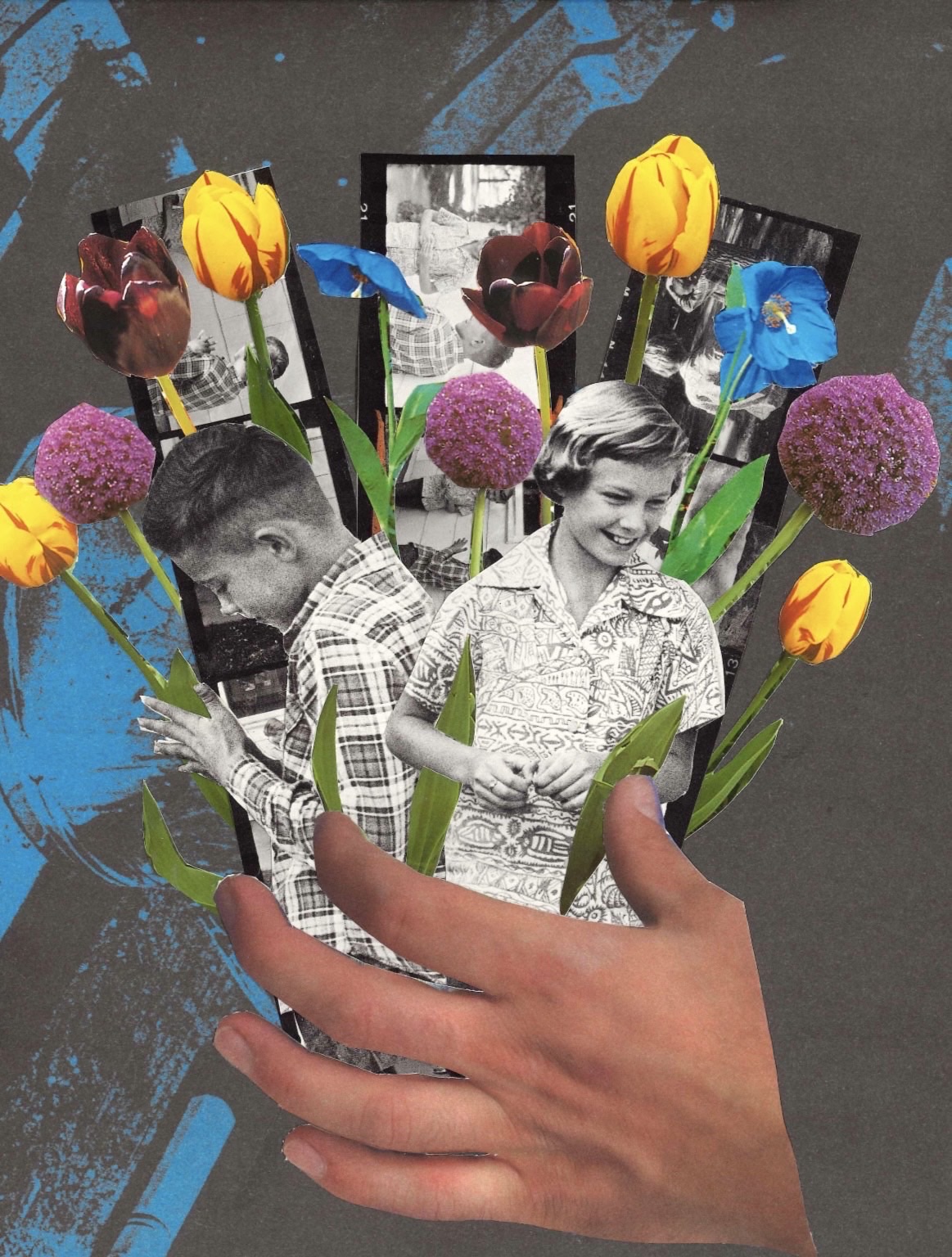
Floridian Beauty
We were Orlando boys. Our seasons marked by the changing of sports. The autumnal colors of football fields with their pom-poms and helmet-berries, the shining ice-flat basketball courts of winter. Spring was a baseball in flower, hats and bats in bloom, and summer was everything, lakes and beaches, theme parks, water parks, pools. You could ride out the rest of your life from one of those summers.
There were seven of us: myself, my three younger brothers, and three cousins who lived nearby in a cul-de-sac—the “ball-de-sac,” we called it. My brothers and I would hike, bike, sprint, or scooter up our busy street and cut into the quiet of their genteel neighborhood. They had video games. They had a trampoline. They ate shrimp and crème brûlée. I remember squeezing the shrimp from their juicy tails, and later, on the patio, tapping with a spoon the hard burnt sugar until it cracked, as the orange-pink Florida evening eased its way down.
“Don’t move,” said my cousin Nolan.
“I don’t want to,” I said.
“No,” he whispered. “I mean…” He leaned over and clapped his hands in front of my face. “Mosquito.”
“I thought you meant Massachusetts.”
“Oh.”
According to my parents, we were moving to a place called Ross, Massachusetts, in August. I pictured the town as a giant discount department store. Moving to Ross, Massachusetts, my parents said, was important for my father’s career, and more importantly, it was God’s will. My father was to be the headmaster of a Christian school. In Ross, Massachusetts, we could buy a bigger house and save for college. There would be seasons, my mother said. We already had seasons, I told her.
“It’ll be okay,” said Nolan.
“How?”
Nolan was going into ninth grade, I was going into seventh. He was the closest thing I ever had to an older brother. Years later, when I read about Gatsby’s smile—the way it made you feel fully seen and uniquely important—I thought of Nolan. Now he’s in Atlanta, a futures broker with no use for the past. We haven’t talked in years.
“God is in control,” he told me on the patio.
We played baseball in the dusk on full stomachs. The scent of acorns crushed on the curbsides wafted up to penetrate our nostrils, our amygdalas, our distant sense of middle-aged nostalgia. A teenager named Miguel, who had once explained sex to Nolan, who had later explained it to me, watched us from a neighboring porch. It was a pitiful spectacle of grounders and pop flies. Miguel walked over and spit brown liquid on the curb.
“The bat,” he said, taking it from my hands, “is like a girl’s leg. Picture this really hot ballerina’s leg on tiptoe. Grip it here. Don’t crush her toes. Now the sweet spot, the place to make contact, is where the calf comes out. The plumpness of the calf.” He rubbed the spot to demonstrate. “There’s a ripeness here. Imbetween—imbetween her knee and shin.”
He rubbed it again, kissed it, then closed his eyes and started licking the air above the end of the bat, which I didn’t understand. That part hadn’t been explained to me. I felt embarrassed and somehow afraid, but Nolan and his brothers yipped with laughter.
Miguel handed me the bat. “Honor the sweet spot, hombre.”
“Sure,” I said, and stepping up to the plate—an actual porcelain dish we’d commandeered from Aunt Portia’s cabinet—I whispered Miguel’s word, “imbetween.” I knew you couldn’t will yourself to hit from the sweet spot—this was a matter of practice, muscle memory, and luck—but remembering it was there, that mystic point, that magic locus, made the practice feel worthwhile.
–
I later learned that Miguel had never played baseball in his life, but so what? I started finding the sweet spot everywhere. That pocket in the glove that caught the ball, hugging the seams, both tender and robust. That sliver in spacetime where you landed on the trampoline to give, or to receive, a double-bounce.
I was discovering that summer, in a book taken up by chance, a species of Christianity that was not only learned beyond my comprehension but answered to a longing I’d never named. It was called Surprised by Joy. The deep, logic-free desiring of my dreams had an object. Not only should it not be suppressed, it should be kindled and expanded to embrace an infinite brilliance. Art, poetry, travel, anything that buoyed the sense of beauty had a place in the spiritual life. It was beginning to sink in that God was just what Jesus said he was, a father, creating us all for nothing less than to share in his pleasure.
I sensed him in a storm off New Smyrna Beach. The crackling overture of thunder, the pajama-snug feeling of shelter and extended family. This was an hour northeast of Orlando, an extension of home, an outstretched limb. Dark clouds a few miles off drifted over the ocean, amassing themselves as if to lay siege to our condominium haven, and I felt a thrill. Let the storm come. Nothing could touch us. And the rain in ragged cloths of gray fell into the sea.
Nolan, from the balcony, pointed to a girl in a peach bikini strutting on the shoreline, where the sun still shone in shifting, indecisive beams. “Check out her gait,” he said.
My father laughed. “Her what?”
“Gait. The way she flaunts her stuff.”
My dad said Nolan should go talk to her.
Nolan pondered. “I couldn’t, but you know who would? Mark.”
My brother Mark was ten years old. The girl looked about sixteen.
“I’ll pay you twenty dollars,” Nolan said.
Mark didn’t say a word. He got up from his chair and slid the balcony door.
“Hey,” my dad said. “Mark!”
A minute later he was jogging on the sand below us, looking as lost as a tourist. We pointed. Mark found her on a towel. He sat in the sand and began a discourse, as he told us afterward, about the Hot Wheels computer game. Her name was Julianna, he told us. She was nice.
“I shared the gospel with her,” Mark said.
“You what?”
“She accepted Christ.”
We dogpiled him with questions, and he answered them one by one. Yes, he was serious. Yes, he had jumped straight from Hot Wheels to heaven and hell.
“Then I said Christian girls don’t wear bikinis.”
The stucco walls of the balcony echoed with laughter. “So what,” said Uncle Benny, “you told her to take it off?”
“No!” Mark said. “Just for next time, something more—what’s it called—modest.”
Mark is a pastor now. Sometimes we talk theology over the phone. He calls himself a Cessationist, which means he believes that after the Apostolic Age, miracles stopped happening. We must look to the past for our miracles. I remind him of our own past, and he laughs and swears that he no longer dares to tell women how to dress.
Nolan coughed up his twenty bucks and with his winnings, Mark demanded Blockbuster.
“I can drive,” said Daniel, the oldest cousin. “It’s barely a mile.”
And though Daniel was only fifteen, and though a storm was on its way, the grown-ups of that era let us go. Seven boys piled into an SUV, Nolan sitting shotgun, blasting Dashboard Confessional as the windshield wipers danced, and we rolled the windows down and thrust our hands out for the first drops of rain and felt created for that specific time and place.
The sweet spot, I thought, was a roller coaster cranking up, releasing—that hovering fringe before the fall. In a grocery store, where the bread aisle kissed the coffee aisle, sharing their breath. That pocket, that pop, that clicking in place. The swoosh of the basketball net from a high, arcing shot. It was a cannonball, tish, glunk, that maximum displacement of water, the drizzle of its applause on a pool deck.
“I’m missing your bed! I never sleep!” we sang, shouting till our throats hurt, drumming the doors and cupholders. How did we, who had never had girlfriends, find such sweetness in those anthems of despair? It was like the pleasure of a scary movie, or of being indoors during a storm, but I craved such heartbreak for myself. To taste firsthand a thing so good that its loss would tear me open.
Who could have known—who could have imagined, as we sat there crammed and dancing—that we’d be scattered in different cities, lost to each other forever? If an angel had appeared and told us the future, we’d have torn his wings off.
“New coats of paint,” we sang, “will not reacquaint broken hearts to brokeeeeeen hooooooooomes…”
The sweet spot was my impending Orlando adolescence. All my life was cranking up to now, this threshold of destiny, and God had my back. On the Sunday after my parents first dropped the outlandish phrase “Ross, Massachusetts,” our pastor had preached on the Parable of the Importunate Widow. Though poor, she got her way by begging and bugging the judge. How much more, the pastor said, will our loving Father answer a relentless prayer?
And I was relentless. I nagged him morning and night, skipped meals, developed insomnia. Throughout the day my tongue formed silently the words, “Orlando, Lord, Orlando.” Looking out the windows of my aunt’s Explorer, touched by the rain, I felt reassured. God was no absentee father. He showed up. He came through. All things worked together for the good of those who loved him, and I did.
–
Blockbuster smelled of new plastic, buttered popcorn, and a quest. Piling through the door, we added the scents of sunscreen and rain. A spacey employee—a young man whom I now understand to have been completely stoned—gawked at one of the screens, which played clips from Deuce Bigalow: Male Gigolo on a loop, eternally.
We walked around, twined through the aisles, got our bodies involved in the choosing, made proposals and shot them down like a school of peripatetics. My brothers and I could see only G and PG, while our cousins were privy to cultural watersheds like Titanic and The Waterboy. They were always mimicking Adam Sandler’s “high-quality H2O,” and my brothers and I joined in, mimicking their mimicry, pretending—almost convincing ourselves—we were in on the joke.
“Let’s rent this,” I said, grabbing The Sound of Music—my mother’s favorite movie—and holding it up for our collective manly scorn.
“Whoa, mama,” Nolan said as he brandished American Beauty. We crowded around and looked at the most stunning girl we’d ever seen, who lay naked but for two defenseless bridges of red petals.
“Wendy Peffercorn’s hotter,” Daniel said, alluding to the lifeguard in The Sandlot, but the claim was debatable, and we debated it at length. I looked outside. Rain dotted the sidewalk. Wind shook the palm trees, and the parking lot grew dim but for lightning that blazed white in puddles and wet pavement. Orlando, Lord.
The debate ended when the door crashed open and two girls with dripping hair came stumbling inside. One of them I recognized. Peach bikini. She was still wearing it. She stood tall and gathered her hair in a tangled bun, and Wendy Peffercorn and the girl from American Beauty melted away.
Peach Bikini’s flip-flops slapped her heels and scuffed the carpet as she sauntered to New Releases, and I watched her plump avocado calves. Every aisle she touched became a runway.
“Julianna!” Mark called out, waving.
She looked over. I flinched, ducking down, embarrassed to be seen with the evangelist.
“Mark?” she said, gliding toward us with her gait. “What a friggin coinkydink!”
She introduced her friend, a short brunette in jeans. “Brandi,” she said, “just moved from the other Orange County, so—you know. She grew up on that sad little guinea pig called Disneyland. As for me, just call me Joule, like the unit of energy.”
Mark introduced us boys in order of age. “This is my cousin Daniel, he knows all punk music. This is my cousin Nolan, the fastest runner alive. This is my brother Cooper, he reads. I’m Mark. This is my cousin A.J., he can do a kickflip. This is my brother Amos, he makes movies, and this is Jonathan, my youngest brother, he can already sink a three. We’re Seminoles, so if you like the Gators, you can just, you know, skedaddle.” Mark laughed at his own pretense of bravado.
“I don’t care for sports,” Brandi said.
“I’m a Gator,” said Julianna, clapping her hands in the chomping motion.
Nolan and Amos came back with the tomahawk chop, and many scores and statistics were cited, and Julianna knew them all and had her own store of arguments. She looked younger up close. Her face was my age, floating above a body that moved in another, future dimension. Her eyes, the green of St. Augustine grass, sank to see the case in my hand. “I love Sound of Music,” she said.
Her voice was artless. An Orlando voice. Hearing it, you knew she had one of those personalities in whose presence you might drop all the flimsy drapery you’d mistaken for your convictions.
“It’s a great film,” I said.
We all talked a while. Exchanged the names of schools and lakes, theme parks we had season passes to. The storm slapped at the windows like a child wanting attention. We ignored it, and soon, for vengeance, it made something crash outside and the store went dark.
Brandi made a wounded animal squeal, which only propelled the mounting urge among us boys to prove we were not only unafraid, but even delighted in outages and predicaments of all kinds. A chorus of shrieks and cracking voices rang out:
“Allllllllllllllll—”
“If peeing your pants is cool—”
“My bum is on the cheese!”
“—consider me Miles Davis.”
“—righty then.”
Julianna, who had been laughing, suddenly went quiet. Brandi screamed. The Blockbuster man had appeared out of nowhere with his face lit by a scented candle. “Power’s out.”
We thanked him for the update.
“Got parents?”
We did.
“To pick you up, I mean.”
Daniel, standing by the windows, reported that a fallen telephone pole was blocking the exit.
“Unwad your little panties,” Nolan said. “We’ll drive around.”
“Where?”
“In the grass, genius.”
“Get over here, genius.”
We all walked over. By the glimmers of lightning and sweeps of passing headlights, we pieced together our situation.
“That grass,” Daniel said, “is a steep ditch. And it’s filling with water. You wanna drive in there? Be my guest.”
Nolan had no comeback.
Brandi shrieked. “We’re trapped?”
“Girl,” said Julianna. “We rode bikes.”
“But the storm—I told you—”
“We’ll wait till it dies down.”
“Dies down? What if we die down? We’re gonna die in a Blockbuster!”
“There are worse ways,” said the candlelit employee. “It’s almost like poetic justice, for me.”
Daniel was at the desk holding the beige phone receiver to his ear. He shook his head. “Anyone got a cell?”
The Blockbuster guy pulled one out of his pocket. “Two bucks a call,” he said, “or a kiss from this one.” He looked at Julianna.
She stepped forward, put a hand on her breast, and pulled out a wad of cash. “One. Two.” She took the cell phone and gave it to Daniel.
“Don’t you wanna call first?”
“My mom doesn’t give a shit,” she said.
Daniel called Aunt Portia, gave her the 411, said we’d leave as soon as the pole—the pole…
“Mom?” He tried again. No signal.
Nolan gave me a nod. I followed him to the door as Daniel asked where in the bejesus we thought we were going.
“Someone’s gotta move it,” Nolan said, shouldering the door against the wind.
“You’re gonna get fried!” Daniel yelled as he followed us, and the rest of the boys came with him.
We ran sloshing through the puddles, Daniel screaming something, Nolan screaming back. A traffic jam lit our path. The seven of us bent down to take hold of the wooden pole. I could see the blur of Julianna through the window, peach fabric, olive skin, holding an orb of glimmering orange light.
We bent our knees, Nolan counted to three, we screamed, and the pole didn’t budge. Six-year-old Jonathan’s hands slipped off and he ran to me holding up a finger, shouting, “Splinter!” and I walked him back to the store. Julianna held the door for us. She took Jonathan in her arms. He must’ve weighed fifty pounds, but she draped his dripping arms around her neck and held him, rocking back and forth. When he’d quieted down, she took tweezers from her purse and plucked the splinter out.
There was nothing to do but wait. The Blockbuster guy—his nametag said MAG, so we dubbed him Maggot—dashed off to a storage room and came back with more candles and a skunky smell, and he said we could eat the popcorn, it was getting cold anyway. We sat in a circle on the carpet, lit by candles, devouring popcorn and candy, guzzling soda, and watching, through the glass storefront, webs of lightning twisting over distant buildings.
“This beats a movie,” Mark said.
Brandi chugged Mountain Dew and crushed the plastic bottle nervously against her jeans. Julianna eyed the bottle.
“What?” Brandi said.
Lifting an eyebrow, Julianna looked at the bottle again.
“You serious right now?” Brandi said. “Are you clinically stupid? Not a chance. Not one chance.”
A.J. piped up with the obligatory line: “So you’re telling me there’s a chance.”
“Chance of what?” said Nolan.
Julianna unwedged the bottle from under Brandi’s fist. I was already sweating. I’d heard of this game, seen glimpses in movies at the houses of friends, caught whispers from kids in the grades above me.
“You first?” said Julianna.
Brandi looked as though she had just been handed a carcass.
“K, I’ll go,” Julianna said.
Mark asked what the game was and cackled as she explained it, finding the whole thing gloriously absurd. Nolan chimed in as though he’d played it many times. Daniel shook his head like a man who had grown too old for such buffoonery, and yet, when Julianna placed her hand on the bottle for the official spin, he leaned forward. We all did.
“Here, bottle,” Maggot said. “Here, bottle, bottle, bottle.”
“It’s not a kitten,” said Brandi.
The bottle stopped on Jonathan. We all said “Oooooo,” and as he looked around, bewildered, Julianna planted a kiss on his forehead that he promptly wiped off. She lifted his hand and kissed the finger where the splinter had been. This he allowed.
Julianna turned to Brandi. “Will you spin?”
“No.”
“Don’t party-poop.”
“No.”
“Will you?”
“No!” Brandi said, spinning the bottle ferociously as the candles glared in her eyes.
The cap pointed square at Daniel.
“Oh, come on,” he said. “I’m not gonna kiss someone in front of all these kids.”
“We got a storage room,” said Maggot. He hopped up, grabbed a candle, and took Daniel by the arm. “Right this way, my righteous dude.”
Brandi, to my surprise, not only followed but had a grin on her face. Maggot came back without the candle. “Let’s give the happy couple some alone time,” he said. “Shall we spin again to see who’s next?” He licked his lips, staring at Julianna.
She shrugged and spun a half-full bottle of Surge this time, counterclockwise, and it slowed to a dubious stop between Nolan and me. I felt he wanted it, but casually he said, “I don’t know. That’s you, right?”
Nolan knew my tendency to lean away, to let others cut in line and stake their claims.
“Yes,” I said, leaning in toward the bottle. “That’s me.”
“Cooper,” Mark whispered. “Be careful—”
“It’ll be fine,” I snapped.
When Daniel and Brandi came back, they were shy. Apparently, a couple years later, they dated for a while. But Daniel enlisted and Brandi sank deep into a Lethe of pills. Last I heard, she was out of rehab, teaching Florida history to fourth graders. Daniel, meanwhile, after two tours in Iraq, moved out to Chattanooga, where he plays Ulysses S. Grant in Civil War reenactments.
Julianna took the candle and, with her other hand, my wrist. An orange light outlined the bun above her head as I trailed her down the Action aisle, witnessed by the glimmering faces of Will Smith, Uma Thurman, Jackie Chan. The string on her back was tied in a delicate bow that bounced as she walked, as though asking to be undone, like a butterfly with a death wish.
In the storage room she shone the candle on shelves of spray bottles, sponges, cardboard boxes. “I’m sure he keeps his pot in here.”
“Why do you want a pot?” I said.
She set the candle on a shelf and leaned against the wall. “Ever try it?”
I shook my head no.
From her purse she took a Ziploc bag of gummies—not bears, but misshapen monsters. “Try one,” she said, dropping a green little freak into my palm.
I held it up in the candlelight. “Pot gummies,” I said.
“Pot gummies, yeah. Don’t scratch.”
I had a mosquito bite on my neck. “Monsters,” I said. “Freaks.” I kept scratching until she stopped my hand.
“You’ll make it worse,” she said. “Surrender to the itch.”
“Surrender to the itch,” I said.
“It’s like quicksand,” she said. “Like Chinese finger traps. Relax.” She set the Ziploc down and pulled my head into the warmth of her neck. She shook. I leaned against her and I shook. Her purse hung twirling from her arm. Where was I? The notches of her spine felt like ice cubes sealed in a package of paper skin. Her eyes closed and I knew I should close mine, but I wanted to keep them open, to watch her cheek and her hair glowing in the candlelight. The kiss lasted a few seconds. She tasted like saltwater, Sprite, and orange Starburst.
“Hey,” she said, picking up the candle. “There’s dollies.”
“Dollies?”
She studied my face. “You okay? That wasn’t your first kiss or something, was it?”
“Oh, no,” I said. “Nah.”
Within ten minutes, Daniel, Nolan, and I were sliding the dollies under the telephone pole, which we lifted and dropped into the grass. We offered the girls a ride and threw their dripping bikes into the trunk and we crammed, all nine of us, into the Explorer, waving wildly to Maggot who stood like an orphan under the eaves.
Brandi sat shotgun, guiding Daniel, while the rest of us belted “The Swiss Army Romance.” Julianna knew every word. She was sitting halfway on my lap, falling into me as Daniel swerved. It seemed that everything—our voices, the squeaking thud of the windshield wipers, the muggy air, the coolness of Julianna’s skin—mingled to form one sensation, an idea born in the mind of God before the universe banged into being and held there after the death of the final star.
When Daniel parked, Nolan and I lifted the bicycles out and all seven of us walked the girls upstairs.
“See you tomorrow?” Nolan said, and they laughed and went inside.
–
There is no conversation in life like that between boys as they lie in bed. It was a time for trading secrets, airing doubts, confessing, shaping amorphous hopes into delicate verbal structures. Girls could somehow conduct such talk in daylight, in hallways, at lunch tables. We saved it up and spilled our inarticulate guts in darkness, when the door was shut and the world unconscious.
But Nolan, that night, was quiet. As we lay in twin beds, I told him all about the storage room. He tried to be enthusiastic, but I could tell. He wished it was him. After a while, we both got quiet. He had his cul-de-sac, I thought, he went on cruises. The most exciting part of my Christmas was seeing what he and his brothers got.
“Think you’ll eat that gummy?” he said.
“Maybe.”
“Or we could split it,” he said.
Again we were quiet, thinking our separate thoughts, thinking of the future. We couldn’t see then how far we would drift apart. Icebergs afloat on different courses. Great stones catapulted by different ambitions, jealousies, resentments. I squeezed the green gummy in my fist.
“Don’t cry,” he said. “Even if you do move, we’ll visit, and you’ll visit here.”
“I know. But I’ll be a visitor.”
When Nolan fell asleep, I gulped the gummy whole. In the lamplight I read my C.S. Lewis and listened to the ocean’s melancholy roar. Something was calling me. I saw myself sneaking out, down the stairwell, past the pool, down the wooden steps, and standing on the beach. The moonlight glittered in tapering bars, and there she stood. She took my arm. We lay in the warm sand, and the night never ended.
–
In the morning, the girls found us. It seemed we’d been friends for years. We played Frisbee, soccer, sand volleyball. We walked along the shore where the damp sand cupped and sucked our heels. We passed castles and tunnels, skimboards and lazy old ladies in the shade with erotic books.
We went bodysurfing. I stood by Julianna, out where our heads bobbed in the water, waiting for the perfect wave. We dove into its toppling, let it catch, let it lift our chests, and we rode like needles on its liquid groove. Washing ashore I looked at the mackerel clouds and the coastline, where everything buzzed and shimmered, coming loose from itself, and the fronds of palmettos dangled with pearls of rain.
–
Some months later, in Ross, Massachusetts, I was chatting with Julianna through AOL Instant Messenger. There is a generation reaching middle age for whom those tones, unheard now for decades—the creaking door of a friend logging on, the ascending and descending angels of messages sent and messages received—will forever be the most powerful sounds in the world. They are charged with young love, entangled with hope.
It’s good, Julianna told me, that you gave up resisting. That you moved away willingly. Like the time we went bodysurfing, she said. The wave came and we surrendered. Had we struggled, it would have thrown us like loose oars.
I wasn’t so sure. I told her, as the angelic tones flew back and forth, that the waves didn’t simply take us—we chose them, we dove into them. I quoted a poem I’d read in school: “To strive, to seek, to find, and not to yield.” She knew all about that poem. She said the speaker, Ulysses, ended up drowned.
I told her about the airplane. How it had felt, taking off, leaving Orlando for good. How all the lakes were gleaming, all my Orlando lakes, how I watched them get smaller, fading in a white fog—vapor.
Our conversations faded like the lakes. Within a year we were strangers, as all of us, I guess, are strangers to countless former friends and formerly significant others. How briefly we enter certain orbits, how deeply memory digs its heels.
Years later, on a family vacation, I walked alone to that Blockbuster and found it abandoned. In my twenties, I found it transformed into a cell phone store, and now, as I’m nearing forty, it’s a vape shop. This morning as my wife and our two daughters sculpted sandcastles, I walked the mile to Vape Central and chatted with a man who worked there. He looked familiar.
I said, “Your name isn’t Mag, by chance?”
“Mag?” he said, blowing out a long white wisp that smelled of oranges. “Nah, name’s Mick.”
I rambled around the store, recalling the candles and the candy, the New Releases, the Drama, the Action. There was something underneath all that. My wife says I’m too nostalgic, and I tell her there was—there still is—something underneath, a nerve, some live wire. I’m trying to get to that pulsing thing.
“Be here, now,” she says. She’s a yoga instructor.
“I am here, now,” I tell her. “And here, now, memories are smashing against my psyche like tidal waves.”
She breathes in.
I tell her all this buzzing urgent newness we call the present is just the raw stuff of a future nostalgia.
She breathes out.
“Can I help you find something?” Mick said.
“Maybe. Any chance I could peek in the storage closet?”
“What for?”
“No reason. I just think God might be in there.”
Mick started belly-laughing. “Be my fucking guest.”
He opened the door, flicked on the light. There were shelves, mops, brooms, boxes. I closed my eyes. I tried to see her. The candle flickering, the purse twirling from her arm.
“Well? Is he in there?”
I thanked him and left the store. The sun was blinding as I walked back. I was sweaty and thirsty and tired. All that beauty bottled up, all that tenderness, the dream-drenched wonder, the elusive marvel of it, how it all got lost, vaporized, how do you live with it? How do you live?
“Dad,” my older daughter said, “where did you go?”
“I took a walk.”
She handed me a shovel. “Help build the castle.”
“Sure.”
Joule took my hand. “Daddy went to our Blockbuster.”
“What’s block blister?” my younger daughter said.
When I was thirty, I tracked Julianna down. She was still @aol.com. I moved back to Orlando, won her over, and built the life I wanted. I wanted all my life to be the sweet spot, but the sweet spot is like water. Even if you grab it, if you cup it in your palms, it slips away.
Then sometimes, out of nowhere, it rains.
“Let’s go inside, girls,” Joule said.
I closed my eyes.
“But our castle!”
“Girls.”
I felt the drops on my nose and forehead.
“Dad! We have to go inside!”
I opened my hands and felt it, rain, on my palms and fingertips.
“Dad!”
I leapt up snarling like a monster, lifted the girls to my shoulders, and ran up the beach as they screamed with laughter. Under our condo’s eaves, we watched their mother nearing like a vision in mist. She wears a blue bikini now. She walks with a calm, swaying gait, a different confidence. Her calves have grown tough, angular with age. She doesn’t solve the riddles of my life. She doesn’t complete me, she is not like the movies. She is not the girl I remember. She is more than I can say.
Sometimes I catch her in the imbetween, half-sleeping, and ask, “Why do you love me?”
“Next to you,” she mumbles, “I feel smart.”
She catches me off guard. She catches me. Sometimes, when I lean into her, she bears me to the shore. Sometimes, laying my ear on her chest, I think I hear the life underneath all memories.
Author Bryce Taylor writes from Houston, and his fiction and poetry have appeared in Image, America, and Portland Review.
Artist Kale Hensley is a West Virginian by birth and a poet by faith. You can keep up with them at kalehens.com.
 Gulf Stream Magazine