
by Travis Cohen
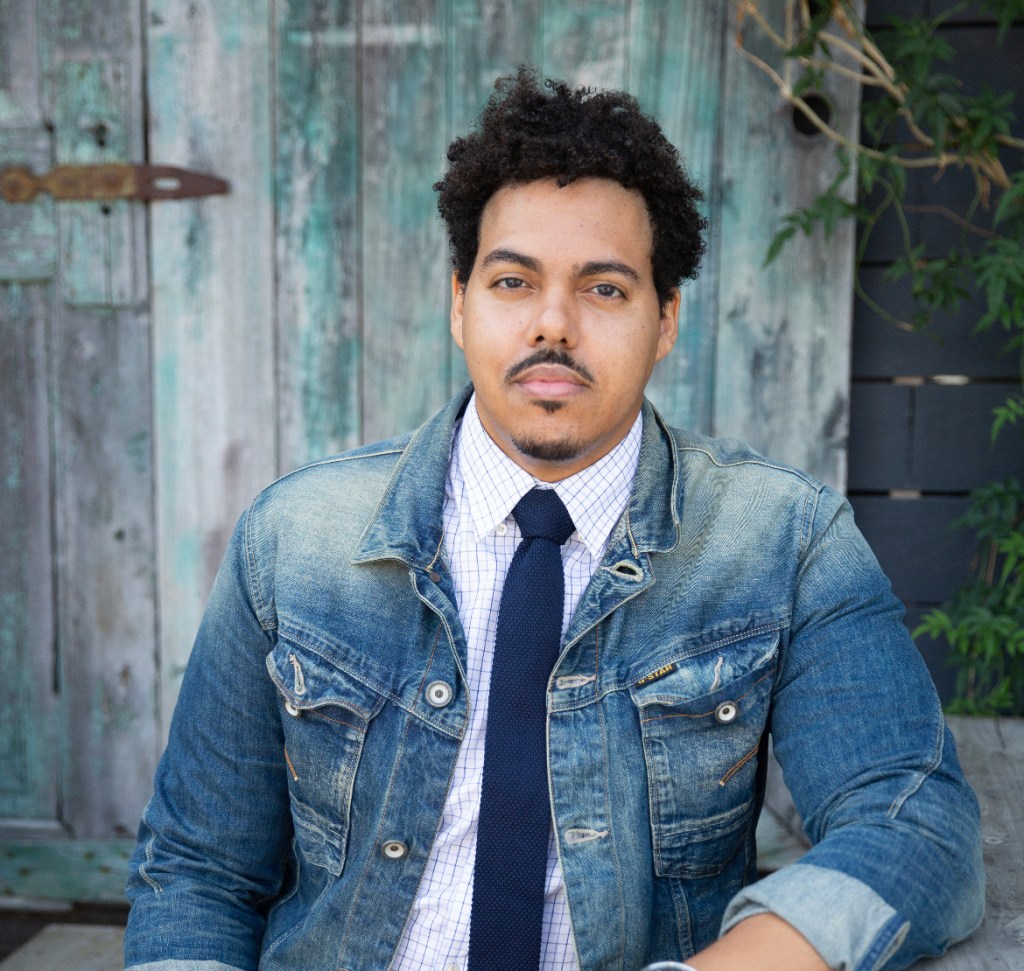
Jonathan Escoffery is an author whose work defies both definition and expectation. His debut book, If I Survive You (MCD Books), which was longlisted for the 2022 National Book Award and shortlisted for the 2023 Booker Prize, is sometimes described as a novel, at others as a linked story collection. It is both and in this respect it transcends both in its exploration of identity, family and belonging. Jonathan was Stegner fellow at Stanford University and recipient of a National Endowment for the Arts fellowship. He received his MFA at the University of Minnesota and studied creative writing as an undergraduate at Florida International University, where recently spoke to Gulf Stream’s Editor-in-Chief Travis Cohen about his work during a visit to his alma mater.
Travis Cohen: Whenever I read a book or a set of stories with linked characters, I think of parents saying they don’t have favorite children. I feel like this is something Trelawney from your book would say he knows is untrue. I’m curious, now that the book has been out in the world for a while, if you see any of the characters as favorites? Who was your favorite to write? Who’s maybe your favorite now that you’ve got some distance, if that’s changed over time?
Jonathan Escoffery: Maybe it’s a predictable answer, but I think it’s still Trelawney. To me, he’s the most complex character, in the sense that he is very observant and very intelligent but can’t really figure out what to do. He’s his own biggest obstacle in ways that I love because we get to go to all these fun places with him. I call it fun – they’re fun to write, dark places, moments of desperation. I think we see moments of desperation with the other central characters, but he was really interesting. Whereas his brother has a moment of desperation that even if you don’t agree with what he does, you know what he’s done, and you know what his motivation is and you know the obstacles in his way. With Trelawney, I think it’s a little bit more complex. He may want something very simple, such as gas money, so that he can continue to not get his vehicle towed. And he’s literally starving. But at the same time, the kind of immediate predicaments that he’s in, for instance when he’s meeting up with this Chastity character, these allow us to look at all these different angles of identity. To me that’s more fascinating.
To me, that’s where the endless kind of energy is. Unless we get inside a Chastity’s head, we can’t know for sure what she’s really after and we end up asking “Is what Trelawney does in the circumstance – showing up for the job, doing a version of the job that was advertised – is that right or, wrong? And how wrong is it?” And I think it depends on who’s looking at that situation. I don’t know that putting some of these other characters into those positions would have given that, would have gotten as much juice out of the squeeze.
TC: That makes a lot of sense. I wanted to ask a question related to those different characters and the structure of the book. I remember reading “Splashdown” for the first time and being devastated by it, but also finding it to be this very strong departure after you’d developed such momentum in the interplay between your main characters and your POVs on the page. Then you get to “Splashdown” and suddenly the book has this additional layer. I know this started out as a novel, then transitioned to stories that you wanted to stand on their own, and then became linked in the editing process. One thing I found interesting about this structure is that it gives you a lot of freedom of movement in your transition. The transition from “Splashdown” into “Independent Living” goes from this heartbreaking ending into arguably one of the funniest openings of any of the stories. I’m curious if that factored into wanting to wind up with this structure, that ability to have these deft transitions that give you more range of movement.
JE: The range of movement was really important for me. I wanted to understand what I could get out of telling a story in the second person over the course of decades in the examples of the first couple of stories. Turning away from that, I wanted to see what the third person could do for me in this more atmospheric story of “Splashdown” and then return into “Independent Living.” I wanted to bring it back into that “I” voice and keep it very close to Trelawney. When we’re seeing him in the first story, we’re covering so much of his life and there’s this distance between this child version of him going through these different things and that older voice who’s reinterpreted it through the things he’s learned in those years. He’s remembering things in a way that he’s adding meaning to it. “Independent Living” is a lot more immediate. As is the story that follows with Delano. I wanted to see, given some of those similar pressures of material survival, what his frame of mind would be like in those moments versus when we take away the advantage of retrospect, although I’m not sure whether it is an advantage. But how does he respond in a shorter time frame? And what can we understand about him in that situation? And as you said, some of the moments are comical, some moments are very grim. But I wanted the space to play from moment to moment, to just feel what does each story need. What is each moment calling for? Just standing outside and observing South Beach, where he works in “Independent Living,” you’re going to see some comical things. You’re going to see some absurdity. I think where the place is set, where each story is set, both temporally and in physical location, is also informing the way the narration styles come together, and I wanted to be able to play with that and be loose with that.
TC: That brings up another question I had about the timeline and the ordering. I’m curious how the writing of these stories was kind of birthed, how these all came about. Did they happen to you in order as we find them in the book, did they come out over the course of years? I’m curious how you built this into what it became in terms of the order, the sort of track listing of the book, because the progression works so well, and it isn’t necessarily the only possible order. For instance, you don’t have to start with “In Flux.” It works beautifully, but you could just as easily pick up at the beginning of Topper’s story and follow the thread chronologically. So, I’m curious how these got written and how that factored into your mindset of how to put them together.
JE: It’s funny. I had a bunch of editors who were interested in publishing the book, and one of them, who I really respect, had an idea for really disorienting the reader and starting with “Odd Jobs” and not giving us so much family background or as much interiority as “In Flux” gives. I don’t at all regret going the way I went in terms of order. At the same time, that’s such an interesting idea to me, that in an alternate universe this book starts with a story that’s shorter, stranger, a version where you’re still probably wondering, “What the fuck? Who is this character?” And maybe, hopefully, you would have the interest to figure that out by reading forward.
For me, the book started with these brothers, Trelawney and Delano, and in the background, Topper was hovering about as their kind of landlord father. It was a story that I worked on right before I applied to MFA programs. Once I accepted my seat at University of Minnesota, that’s where I started really working on the book. I was about to say I think the first story I wrote was the Delano story, “If He Suspected He’d Get Someone Killed This Morning, Delano Would Never Leave His Couch.” To me, I already had a Trelawney story, so I was looking at this as chapter 2. I still wanted it to be a chapter that stood alone. It was essentially the same story that’s in the book, but line by line, it was a lot uglier, it was messier, there were a lot of redundancies, the sentences weren’t as clean. I’m pretty sure I wrote that in my either my first or my second semester at the U of Minnesota. In a way, that’s the earliest story that made it into the book, except that I had worked on an essay at FIU, in Lynne Barrett’s workshop, where I was writing about this crazy elderly housing place that I worked at on Miami Beach. The story was published in Prairie Schooner under a different title, ” Chasing Carlos.” I began that as an essay, but I can always make my narrative essays a lot more intriguing and interesting by turning them into fiction and maximizing the tension by not sticking to what actually happened. So, that was the earliest story that I wrote. But it wasn’t Trelawney. I had to look back at it and turn the character into Trelawney and think about where Trelawney was in his life to be at that job and start manipulating it that way.
From there, I wrote a ton of stories that never made it into the book that followed the same characters. Then probably “In Flux.” It was really when I wrote “In Flux” that I knew I had a real book, not just a bunch of stories. That’s where I understood the rhythm of the book and the musicality that was going to play out and the way humor would be balanced with sadness. “Pestilence” came right after I wrote “In Flux” or maybe right before. I wrote “Splashdown” in my program as well, so that’s somewhere in the middle. It gets so murky for me. Where I began the stories and when I actually consider them finished in terms of revisions can be hard to keep track because I do so many revisions, usually around 50 revisions of each story. And sometimes I don’t think they changed that much in the big obvious ways, but they definitely changed a ton on the line level. That’s what kind of keeps me misremembering when I started and finished a story, because I may have started three more after that one and finished three more before finishing that original story.
TC: Going off of that, you have these stories that have these huge pieces of plotting that you’ve got to keep straight across the book. The bare movements of that, how you tie those moves together both across the book and even just within a finite story that stands alone, that in and of itself is really incredible. But there’s also so many beautiful lyrical lines. You talk about the musicality of the book and I’m wondering how much of that lyricism found its way to the page in the early drafts as you’re making these moves and how much of that winds up finding its way in during the revision process?
JE: A lot comes in revision. There’s a story I wrote that did not make it into the book, but it was the very first time I wrote about these characters. I thought the musicality and the rhythm and sentence level work were kind of a blueprint for how I wanted the book to be. But I had a really difficult time in drafting the first few stories and in the first revisions of the first few stories that I wrote, matching that original story. I submitted that story for my writing sample for U of Minnesota and I remember my advisor, Charles Baxter, read the first couple stories I brought in and had varying responses. He loved “Splashdown.” That’s the story where he said, “Okay, this is where you need to be.” But he was also reminding me that I could still write humor in these stories. And he didn’t want me to lose that. At some point, I started putting pressure on myself to be more serious, whatever that means, because of what we’d been reading in grad school. To me, the best thing I got out of grad school was just having so much good literature put in front of me that I don’t think I would have found on my own. At the same time, I don’t think we were reading much comical work, work that was really operating at a high level and still brought humor in. I was caught somewhere between feeling like I had to match the humor of that first story, which was too much pressure, and at the same time, there was some quiet voice in the back of my head saying, “That’s not what serious writing should be doing in the first place.” It wasn’t really until after I got out of grad school that I allowed myself to get back to the lyricism part and the kind of humor, the sarcastic eye that Trelawney brings into most of the stories that he’s featured in.
It’s half and half in terms of your original question, though. Sometimes, if I’m getting several pages into a story and it feels lifeless in that there isn’t a kind of musicality, lyricism, humor, if it’s just pure plot, I have to find something to keep it going. The engine of “Splashdown” for me was the atmosphere. That’s how I see it. What’s the voice of this place in the Florida Keys? And how is that pushing me forward? That narrative voice, even though it’s third person, it’s kind of a character. I have to feel that there’s something like that in order to feel that it’s worth even finishing the thing. If it’s just coming out as purely dead language on the page, I don’t know how it will transcend things happening and really start to become story if I don’t have one of those other elements pushing me forward.
TC: I want to build off that notion of the voice of this place. Throughout the book, you’ve got some really great Miami-isms, Florida-isms that for me, as a Miami native, make it feel immediately real. I think of ” Odd Jobs” and the phrase “eating shit” because I have been explaining eating shit to people who aren’t from Miami my entire life. And in ” Pestilence,” you do it in a really interesting, clever, subtextual way. Most of the story unfolds in the moments before the storm and you capture the sort of weird tension where the air gets a little bit more charged in the city throughout the progression of the story. You do so much work with place and specificity, and I’m interested in how you think about that specificity and how it works for a writer and for a reader, whether they’re familiar with Kingston or Cutler Bay or not?
JE: Part of it is a simple convention of literary fiction that might be taught in an intro to fiction class, not telling on the page everything that’s in the room or in the city that we would, as reading literate people, already assume is in the room or most major cities. All major cities in the U. S. have highways and streets and roads and things that are obvious. So, when I moved from Miami to Minneapolis and then to Boston and then to Long Beach, I tried to think, “What’s different about Miami? What do I miss about that place that I’m not seeing in these other places?” That’s what I wanted to hone in on, those specifics, so that I’m not trying to overburden myself as the writer, or the reader with too many details. Getting to the significant detail that paints the picture of the place but also capturing the emotional intensity of the narrator who’s remembering this place in the first place. If I had some kind of emotional attachment to what this looks like, I’m going to have a different way of seeing it.
Even though “Pestilence” could be in a totally different book than “Odd Jobs” to me, this is Trelawney’s moment to reflect. He’s been beaten half to death by Chastity’s family and he knows that the decisions that he’s been making are at least a good percentage of the reason why he’s in such a situation. He didn’t have to try to cut down his father’s tree to then get kicked out of his father’s house to then live in his car to then pick this specific job to show up for. And I think he’s gaining some clarity, or he’s at least reaching for some understanding of that fact in those moments. So that’s how, he’s seeing the world and that’s why he’s looking back and asking, “Given that I know that my father would kick me out of the house and have me living on the street, were there moments where he tried to protect me at all? Has he ever tried to protect me?” And he’s looking and he’s seeing that there were moments in his estimation where he did try to protect his feelings. But that kind of goes sideways when he remembers that, in other ways, he did not protect him.
I know that’s a little bit aside from the details of a place but remembering that there’s a kind of psychology that is bringing us to the place and an emotional space that is also translating the place to the reader, that was as important to me as anything.
TC: The idea being that that groundedness and specificity come from a groundedness in the person and the POV experiencing the thing makes sense, I like that a lot. I did want to circle back to something that you said about the books put in front of you in grad school and this question of serious writing. In The LA Review of Books, you said this about writing and standards: “My wish extends beyond editors to include writing instructors and students whose majority status situates them in the seat of power. Standards across our literary landscape seem to be almost entirely based on comps, which dissuade writers from taking new approaches to narrative, or working in lesser-known traditions.” Other than that focus on comps and pointing to the majority rather than the minority of traditionally classical writing, are there any other things that you wish teachers or students did less in the room? Alternatively, are any things that stand out to you aside from the books that were put in front of you that you remember as really impactful positives, things you wish teachers and students did more in the room because they were good for you?
JE: The traditional workshop model has mostly worked for me as long as there were good and diverse reading lists. But there are people that are my peers, that are my friends, in those same classrooms where I noticed some of them were more vocal than others about the fact that it didn’t work for them. I only say that to say that I know I also have my spots that I won’t be able to point out. There’ll be things that are wrong with or complicated about a traditional workshop that I won’t even be able to point to.
There are ways in which I used to think that art is only about mirroring reality as I see it. I’m not saying that’s not an important aspect of it, but in the same ways that dystopian narratives can help us be concerned about climate disaster, I think there are ways in which we can also consider more positive outcomes than we are currently seeing in literature or the real world. I was reading a friend of mine’s book, and I was about three fourths of the way through and I realized that the central relationship in the book was not actually ever going to turn toxic. And I was shocked because I don’t know that I’d ever read a book like that before. There were other problems in the book, but I’ve been trained to read in such a way that if you have people that are in a relationship at the beginning of the book, I am anticipating a breakup. By the end of the book, they should probably not be together, or they should have gone through a heck of a journey in which they maybe salvaged things towards the very end. I just think there are certain expectations and conventions like that, where we really promote conflict in all things as the solution to getting a story to work. I think there’s something a little bit broken in that. I don’t want to read a fiction that has no conflict, but I think we can also have narratives about people who aren’t always quite as broken as we are. I think we start to even imitate the art. All we see in representations of relationships is that someone’s got to be toxic in it, maybe both parties in some ways. Someone’s got to be, either kindly or unkindly, a problem. I’m just at a place in my artistic journey right now where I’m questioning some of that.
As for positives, I love a workshop. I’ve had arguments with my peers about this, but I love the praise rounds of feedback in workshop. I think it’s important to understand who your readers are and who’s giving you critical feedback and who’s telling you such and such thing isn’t working. I don’t think you trust that person until they’ve demonstrated that they can see what is working and they can tell you where the energy is in your manuscripts and what’s exciting about your manuscript. Because if all they see is the bad, then that’s probably just not your reader in the first place. I’ve been in some workshops where we have praise rounds and some people in the workshops say, “Why are we doing this? We’re serious writers at this point, shouldn’t we just get to the what’s wrong with your story part?” I’ve actually really appreciated the professors who will say, “Nothing is wrong with this story. This is pretty much a finished story. Change that semicolon to a colon in the final paragraph and send it to whatever magazine you want.” Some students will think that’s lazy teaching, but if that workshop leader has demonstrated that they’re not doing that with everybody’s story, they’re just recognizing you clearly spent a lot of time on this story. You’ve thought a lot about it. You’ve probably brought it to other workshops before bringing it into this one. Not every manuscript has to be a problem or have a problem.
TC: I like that. Problems are interesting and fiction with problems is usually interesting, but it’s not the only thing that fiction has to be about. Nice things happen. Relationships don’t all go sour. There doesn’t always have to be a problem in the story and there doesn’t always have to be a problem in the workshop to make you feel like you’re doing something. I wanted to talk about that idea of where you are in your artistic journey and what you’re interested in reading and what you’re interested in writing. Earlier this year, I got a chance to interview Hanif Abdurraqib and one of the things that we talked about was that in his estimation, he has three obsessions as a writer. One of our professors at FIU says every poet has six obsessions. I’ve spent a lot of time trying to think of mine, and I’m curious what you think yours are, what you think you’re obsessed with as an author.
JE: I guess one of the questions I’m asking myself is do my obsessions need to stay the same or how much have they changed? I would have said in my first book and in the process of writing it, I was really obsessed with father-son relationships and especially fraught father-son relationships. I brought a story into one of my last workshops at Stanford, a story that had nothing to do with this book or the world I’d been used to writing about, but there was a character who is college age, doing an internship at a place that doesn’t really feel like his position is necessary and they kind of neglect him. To get the story going, I started with this main character talking about the problems that he’s had with his estranged father. The professor, who’d read my last book, said to me, “This feels like a holdover from your last project. This story doesn’t really seem to be interested in that. Does he have to have a bad relationship with his father?” There was a time in my student life where I might have been defensive about that kind of advice. But I think I really needed to hear that. I’m so used to writing about a character who has some kind of issue with his father. But why? Why is that? I know people in the world who have very healthy relationships with their fathers. So, am I creating in this world this narrative that all father-son relationships have to be toxic or damaged or traumatic in one way or another? In asking myself that question, I realized that I think I’m actually finished with that obsession.
I’m still very interested in the way bodies are treated. A simple way to boil this down is to say I’m still obsessed with identity. I don’t know that I’ll always be obsessed with it, but if I were to say, “Oh, I don’t actually identify with my blackness, my Jamaicaness, my sexuality, my gender,” if I tried to claim these things, I would be in denial of the real world and how that operates. I am interested in these kind of moments which claim or deny the body that we’re each kind of trapped in, how those bodies are treated by the outside world and how that can change along regional lines, class lines, what we can literally do to change our bodies, and when we do that – or when we don’t for that matter – what we expect the outside world to make of us and how that can actually play out. I’m thinking of the blackfishing Instagram trend. I don’t know if you’re familiar with that at all, but there is this kind of Instagram model body that is trying to look racially ambiguous, for hundreds of thousands of likes that then bring financial reward. Or the difference in beauty standards, how that’s changing rapidly and we’re seeing cosmetic surgeries are being reversed to go in a different direction and how that plays out in, how there’s financial reward for that. Just the way societal expectations and politics can play out in these really tactile, grounded, dramatized ways, which is what books are great for.
TC: I think that breaking down the different ramifications and interpretations of identity makes a lot of sense as an obsession. It’s something that’s clearly a focal point as the book follows Trelawney through this series of different phases of his own understanding of his identity and other identities. The way he talks about identity is very different in “Independent Living” than the voice he talks about it with in “In Flux.” There are all these different angles that the book looks at identity through, identity as a means to belong, identity as a rejection of belonging. I feel like we wind up at a place where Trelawney is maybe done trying to embody somebody else’s predefined interpretation of his identity. I loved the title that the LA Review of Books gave your interview, “Consciousness of Continuation.” I’m curious what is on the other side of that sort of being done with trying to identify as what people want you to identify as, or being done with how they identify you. You make a great point that the world is going put that on you one way or another. But I’m wondering – whether it’s for you or your characters – what you think is on the other side of that decision to say, “No, I’m done trying to be your version of who I am.”
JE: It’s complicated. I think it goes back to the title of the LA Review of Books, where it’s a continuation. I don’t think the other side of it is a straight line or a fixed place. I think it’s always going to be kind of cyclical. Being done with the identity question, on the one hand, you can call it a delusional place, but I think I look at it as a privileged place. If you’re not being forced to think about this thing, if your rights aren’t being taken away at because of a particular aspect of your identity, then maybe you’re thinking about it a lot less. In Trelawney’s case, he is becoming a little bit more like his brother, where he’s obsessing over how people see him. I think there’s still safety issues in terms of whether the world sees him as a threat and how to avoid move in such a way that he doesn’t run into harm. But I think he’s also gone from this place of receiving the world’s treatment of his body, his identity, his identities, and trying to make sense of it to a place of more motion. As in, “Let me get a roof back over my head. I don’t want to internalize this in the way that the world seems to be asking me to, I just want to move forward and survive.”
I think his obsession in a sense is shifting. He’s asking himself different questions that are less about those more external parts of his identity and more about what kind of human being am I going to be in the world. Should I take bribes and screw over the tenants or the people who are on the waiting list to get into the building? And is that the way everybody else is getting by and he’s just the last person to know? I think he’s looking for these answers when the woman who comes in and essentially bribes him to be able to move into this building. From her perspective, she’s cautious with him. She thinks he must want something more than this money if he’s asking her to meet late at night. And he, in a sense, is looking for guidance. He’s thinking she appears to be someone who doesn’t give a damn about the rules. She seems to know how to bend things to work out in her favor. He almost wants a mentor in that moment. I think that’s what’ s on the other side for him: letting go of those external questions. Obviously, it’s not all external parts of our identity, but in those moments, he’s asking where are my morals and can I bend them? I think towards the end, because he doesn’t do the thing that would get him closer to that promotion that’s being dangled over his head, I think he’s pulling back. He doesn’t want to ultimately be ruthless.
TC: The last thing I wanted to ask is about how you identify as part of a literary landscape. I spend a lot of time thinking about the Miami literary landscape. I think a lot about authors who are part of that lineage, whether it’s Scott Cunningham, who has done so much for the city and building that literary community, or whether it’s Edwidge Danticat, or, Caridad Moro-Gronlier. There is a history of literature here that isn’t necessarily the most widely recognized but that is growing, and that lineage is growing too. I would say that you’re part of that lineage and this book is part of it. I’m curious what it means to you, how you think about being part of that landscape?
JE: It feels amazing. Getting love from the Miami Herald – the Miami Herald was the most read thing in my household, everyone read the Miami Herald. Not everyone read books. And the Miami New Times, especially coming into my teenage years, meant so much to me. And just getting love from them, getting love from the book fair, getting love from Mitchell Kaplan and Books & Books, it Feels, it feels incredible. And then obviously all of the readers outside of those institutions. It makes me happy that my next book is also set here. I don’t know how many more Miami books I have in me, but the next one, the geography and the culture down here, it’s very central to the book.
When I dreamt of putting a book out, I didn’t dream of being on a panel at the Miami Book Fair, so just being involved in it and other parts of Florida, too, with the Key West Literary Seminar, that has just been incredible. It’s really special to me. I don’t know what I’m going to write in the future after this next book, but I wouldn’t have it any other way. There’s no other tradition that I would prefer to be a part of.
Jonathan Escoffery is an author and essayist whose work has appeared in The Paris Review, The New York Times, Agni, The Observer and may others. He was a Wallace Stegner fellow at Stanford University, a recipient of a National Endowment for the Arts fellowship for literature, and a winner of the Plimpton Prize for Fiction. His debut book, If I Survive You, is an international bestseller and was nominated for the National Book Award, the Andrew Carnegie Medal for Excellence, and was a finalist for the Booker Prize.
Travis Cohen is a Cuban American author and poet whose work has appeared in Litbreak Magazine, Every Day Fiction, (In) Parentheses Magazine, Litro and Permafrost and is forthcoming in the South Dakota Review. He is currently enrolled in Florida International University’s MFA program, where he is the Editor-in-Chief of Gulf Stream Magazine.
 Gulf Stream Magazine