
by Scott Nadelson
Forks
There were two sets in the drawer. One had long tines, a curved back attached to a smooth neck, a subtle etched floral pattern at the handle’s end. This was her mother’s set, the one she’d grown up using. The second, her stepfather’s—which had occupied the drawer alone a year ago—was chunky and flat, the handle too wide. And then there was one random fork, brought home accidentally from her stepfather’s work, maybe, or left after a potluck fundraiser her mother hosted for the local Audubon chapter. This last was too light and weirdly proportioned, the tines short, the handle tinted darkly from overwashing.
It was her job to set the table every night, and she always made sure to give her mother and her younger brother the good forks, the ones they’d used back when they lived with their father—a time her brother barely remembered—and during the blissful years when the three of them lived alone in a little two-room bungalow, her mother in one narrow bed, she and her brother in the other. She usually gave herself one of those forks, too, unless she was angry at herself for something she’d done or said, and then she’d suffer through dinner with one of her stepfather’s ungainly utensils, which somehow made everything taste wrong.
If her stepfather preferred his own forks, he never said. He didn’t seem to notice which type she gave him, though she detected something different in his mood depending on her choice. If she gave him his own fork, he’d talk boisterously through the meal, moving his arms a lot and complimenting her mother’s cooking. But he’d also scrutinize her more, keeping an eye out to see whether she put an elbow on the table, for which he’d send her to her room without letting her finish her meal. She was twelve now, he said; it was time to learn some manners. He’d been in the army once, and he talked about posture in a way that sometimes made it seem as if nothing could possibly matter more. She tried to remember to sit up straight, but then he’d start telling a story, gesturing and using funny voices, and his lighthearted tone would get her mother laughing. She’d relax, maybe slouch a little, but the second her elbow touched the table, he quit talking, scowled at her, and told her to take a hike.
When she gave him a fork from her mother’s set, he was quieter, as if the more elegant shape of the metal tamed him. Except the quiet wasn’t a peaceful sort. Instead, he’d stew over something that had happened at work—he managed a produce warehouse and grumbled constantly about his staff, especially those who didn’t speak English without an accent—and start finding fault with things at home. He didn’t notice her posture then, but he’d tell her mother she’d put too much salt in the soup or used too much paprika on the roast. Worse, he’d notice things about her brother, who was still in shock from the sudden change their lives had taken since their mother remarried; he’d wet the bed at least three times in the past six months, though he was nearly ten. Her stepfather would tell him he was getting fat, that he needed to stop stuffing his face with everything he could lay his hands on. He said he’d scour the house, and if he found any cookies hidden away, or any of that sugary cereal they’d been eating before they moved in with him, it was all going into the trash. He didn’t yell, just muttered a persistent stream of dissatisfied words that made her mother stare silently at her dish and her brother clench up beside her, looking at the food he wanted to keep eating but knew he’d better leave aside.
Still, sometimes this was preferable to his focus on her posture and the position of her elbow, so to give herself a break, every few days she’d place one of her mother’s forks on his napkin instead of his own. Last night he’d eaten with the heavy blunt type, and she’d gone to her room before swallowing a few mouthfuls of salad. Tonight she wanted to punish him, though of course there was no way to do so openly. Any obvious rebellion he would immediately crush. He no longer looked like a soldier—his hair grew over the tops of his ears, in the style of the time, and he had a dense brown mustache that covered both lips when his mouth closed—but the severity remained, the instinct to shoot on sight. He hadn’t fought in any wars—Vietnam ended two years before he enlisted—and maybe that made things worse. He needed to make up for the fighting he’d trained for and expected but never experienced.
So, if she fought back, it had to be guerilla-style, a quiet sabotage. The best she could come up with was to give him the random fork that usually lived at the bottom of the drawer, the one she’d never give her mother or brother, both of whom would have noticed instantly and complained. She’d never even given it to herself in the moments she thought she deserved punishment most—when she’d shoved her brother in the hallway for no reason, or when she let a boy at school get away with pinching her behind during gym class and not instantly turning and decking him for fear of getting into trouble. Those times she only gave herself one of her stepfather’s forks, enduring a meal that turned her stomach.
She hadn’t dared to give her stepfather the random fork, either, not until tonight, when anger, followed by curiosity, made her bold. She set the table before he got home from work and picked her fingernails to shreds while he washed his hands and sat for a few minutes in the living room, reading the newspaper. He always needed a little time between getting home and starting dinner. During their first weeks in the house, he’d scolded her mother for having food on the table when he walked in and then again for letting it get cold by the time he was finally ready to eat. So now they all waited, and when they heard him fold the paper, her mother set out their plates.
She watched him ease down into his chair, watched him close his eyes and smell the food—chicken cacciatore, one of her mother’s specialties—and give a little nod. There were times when he acknowledged how lucky he was to have joined this family, especially after the mess he’d made of his first. Tonight, his mood was magnanimous, and she thought maybe she’d made a mistake in giving him the crappy fork, which would turn everything sour. She caught his eyes drifting toward her, realized she’d begun to slouch, and pulled herself upright. She made sure to keep her hands in her lap. No one was supposed to start eating until her mother took the first bite. They waited. Her mother speared a bit of chicken with red pepper, nibbled the end, said, It’s not poison. Then he picked up the fork.
Once again, he didn’t seem to notice it wasn’t one of his usual ones, at least not consciously. But the unfamiliar utensil made his hand move strangely, perhaps because of how little it weighed, and it brought to his face an expression she hadn’t seen before, not the usual disgruntlement that accompanied her mother’s forks, but something a little sadder. There was a hint of a smile on his face, but a tight one, suggesting unease, maybe, or regret. She didn’t trust it and held her breath as he cut a piece of chicken and lifted it to his mouth. He didn’t say anything as he chewed, nor after he swallowed. She was braced for something worse than what they’d seen so far. Maybe now he would yell. Or throw something. He’d never spanked her brother, hadn’t raised a hand to any of them; up to now, his only methods of discipline had been muttering criticisms and sending her to her room without dinner. But that didn’t mean there weren’t other possibilities they hadn’t yet encountered. If she’d made a fatal error, she hoped it would come back to haunt only her and not the others.
But he didn’t yell, and he didn’t throw anything, and he didn’t make a fist. He finished another bite and then said, When I was stationed in Germany, there was a kid in my barracks who talked about his mother’s cooking all the time. He’d go on and on about how much he missed her meatballs and her cannelloni. Or maybe it was cannoli. I don’t know. He was definitely Italian, and everything he talked about had tomatoes in it. The food on our base was terrible, and when we had a pass to go into town, all we could find was bratwurst and sauerkraut. I liked it fine, but he just complained the whole time, whining about how nothing was as good as his mother’s food. Chicken cacciatore. I’m sure that must have been on the list. You two, he said, pointing the flimsy fork at her brother and then at her. You’ll feel the same way when you’re older. Off at college or wherever. You’ll miss this. Never take it for granted.
As he spoke, she’d forgotten to think about her body, and now, too late, realized her elbow had settled beside her plate. She hadn’t even taken a bite yet. The smell of chicken simmered in sauce filled her nose and made her eyes water. She glanced at the elbow, pushed her chair back, and stood. Where do you think you’re going? her stepfather asked. She patted the elbow, pointed at the polished wood. She was too upset with herself to speak. Don’t leave the table without being excused, he said, and the same tight, sad smile remained on his lips, just barely visible behind the thick mustache. Take a seat.
He twirled the cheap fork over his dish and jabbed it down. She tried her best to sit with her shoulders back. He swallowed another bite, and the sad look grew only sadder. She didn’t know what she’d do if he started crying. Damn, that’s good, he said.
Her mother beamed, believing, perhaps, that she hadn’t made a terrible mistake in marrying this man, in bringing her children to live in his house. Her brother pitched food into his mouth as quickly as he could. She lifted her own well-crafted fork, cool against her fingers, and prepared to take a first tentative taste.
Author Scott Nadelson is the author of nine books, most recently the novel, Trust Me. His work has appeared in Ploughshares, New England Review, STORY, Five Points, and the Best American Short Stories.
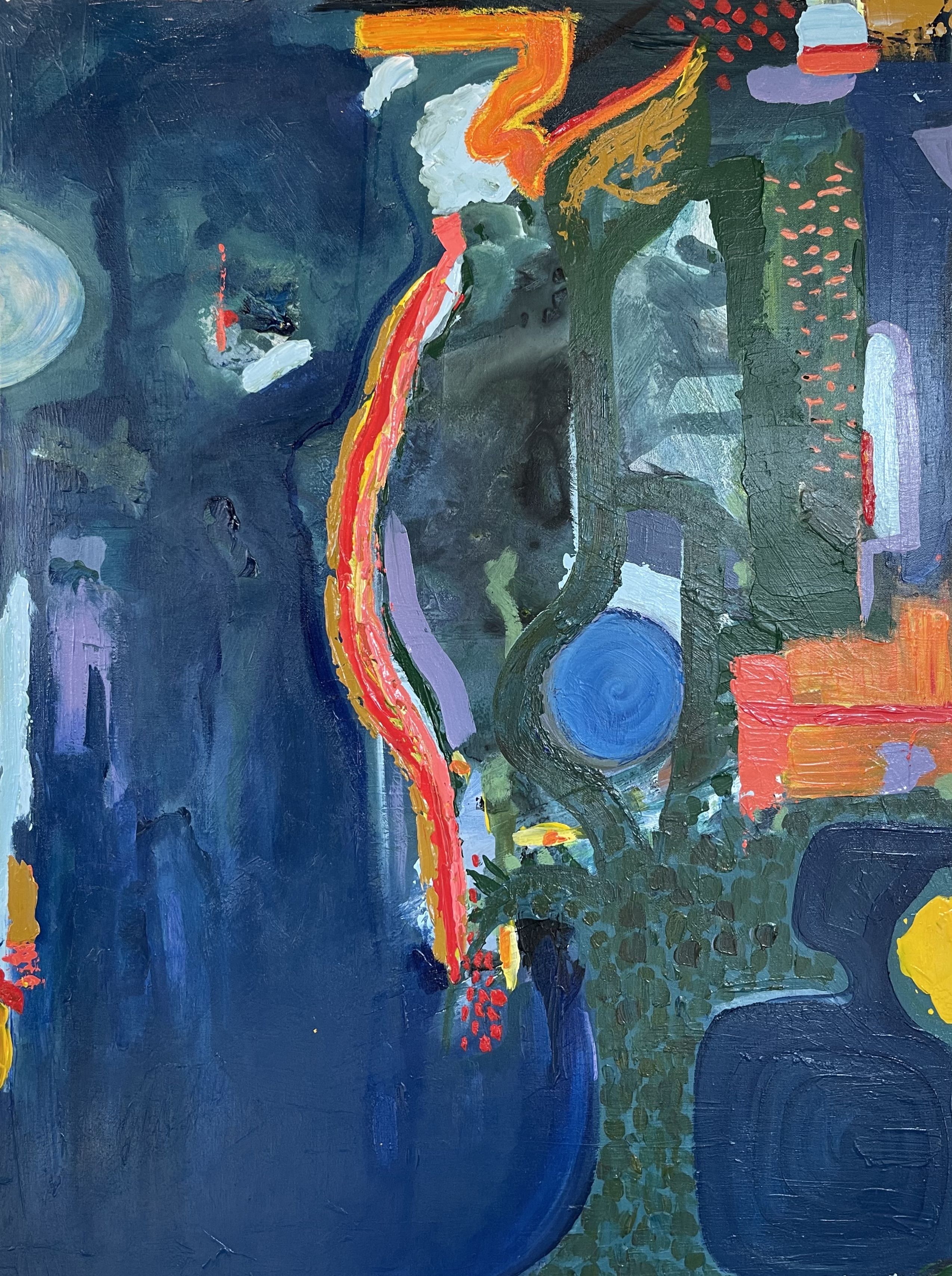
Artist Heather Fleming paints abstract compositions depicting symbolism and nature. Heather received her MFA from Parsons, The New School for Design. Currently, she is working on a large 8 panel piece which will conclude her body of work titled ‘Seek’. The next body of work will focus around the human body, energy and nature. Heather is also a part time adjunct professor at The University of North Alabama.
 Gulf Stream Magazine