
by Caroline Mahala
A Case for More Stuff
I watched my friend, and one of six co-signers for this little unit, try to angle his surfboard over the heap of duffel bags and laundry baskets. The unit was hardly bigger than a walk-in closet, but there was no ceiling, so the board had room to stick out over the top—the last item, like a flag of surrender rising above the horizon. We were college freshmen, and although the combined value of our belongings was likely less than what we paid for the unit that summer, we couldn’t imagine parting with the keepsakes that had become so meaningful to us in the past year. Among the items in my laundry basket were a paper mâché cast of my breasts that I had painted and sprinkled with glitter—which sadly, but predictably, did not survive the move—and a collection of oyster shells and fish bones that had lined my windowsill and attracted ants, much to my roommate’s disdain.
There were the mundane items also. Dirty bedding and plastic shower caddies; the assortment of dorm room essentials that are sold as color-matching bundles at Walmart. People moved like zombies in the Florida heat, pushing their heavy carts in and out of the building. A son moving a floral-printed couch for his elderly mother and a young mom storing baby items away. I also wandered zombie-like through the halls, listening to the echo and faded whispers of my group of friends as I got farther away. The mushrooms I had ingested an hour before were kicking in and the texture of the stucco “popcorn” walls felt good beneath my trailing hands.
I found a catwalk that overlooked this maze of roofless, practically cardboard, units. I could have compared it to honeycomb or something nice, but it instead reminded me of oily pores on a human face. Everything was flushed white and the massive domes of unsettling, yellow light flickered overhead. I felt the mushrooms gurgle and rise in my stomach and started dry heaving as I looked out over the sea of people’s stuff, shoved into holes like body parts or fish guts in a bucket.
At least this is not that, I think ten years later, as I press send on a Venmo payment to the moving company, acquiescing to the amount of cubic feet and additional charges that my loose art supplies and kitchen knives supposedly take up once they’ve been repackaged into boxes. The truck pulls away from the storage facility and will meet me a week later at my new apartment near the University of South Florida campus. I’m returning to the place where my adventures started, now in search of greater stability.
I resent the restriction in mobility that owning furniture has imposed. While I was hiking the Appalachian Trail this summer, I sought to minimize the weight and number of items in my pack, carefully considering what I could and couldn’t live without. Now, I stand in the center of my living room with the A/C blasting and consider which box to open first. On the other side of the door: traffic ripping down the six-lane road, screaming kids running around the pool, and cicadas wailing like women in mourning. There are times when the greatest accomplishment is being able to carry everything you have on your back, and times when having a couch to curl up on means the world.
I can’t figure out how to classify this way of living. Is it urban or suburban? There’s infrastructure all around but nowhere for people to commune and just be. Anti-loitering signs are hung in every storefront it seems, so people gather beneath the shade of a gas station with their shirts hanging from their back pockets. The word ‘sprawl’ comes to mind because of the ever-expanding network of strip malls that developers drain swamps and cut into palm hammocks to build, praying that the asphalt won’t give way in a place with no true bottom. Between the earth’s core and a Publix parking lot are layers of mud, sand, and cracked limestone, eroded by acid rain.
Among the variety of reasons I decided to apply for grad school was the realization that I had run out of willpower to perform unfulfilling jobs in order to support myself. In some ways, the decision-making process is very linear. That is, one affirmative choice leads to the next. But as I sit beside the pool, admiring the live oak trees that surround the perimeter, I’m struck by the way their twisting branches resemble the conditional nature of life. Future chapters are constantly being rewritten, the course altered by accidents, ultimatums, a change of heart, and new discoveries. The possibilities are exciting, although at thirty, it feels like some doors have closed forever. You begin to weigh the things that will happen in your lifetime against the things that will not. I’m fighting the feeling that adding more stuff to my life, like furniture and a master’s degree, represents a shift away from the adventures of my twenties.
Because what did those adventures look like? Toward the end, trying to balance a schedule of weeknight bar-hopping and early morning meetings with corporate leaders. Losing myself in a bottle of Jameson on a Friday night and coming to in the middle of the park, communicating with birds that I had become certain were migrating to the area at earlier and earlier points in the season (disregarding that it was already 5am). Falling in love and watching that person’s brilliance become overshadowed by their alcohol consumption—knowing it would happen to me, too, if I stayed—and eventually realizing that adult relationships require more than love to be self-sustaining.
I’ve seen the most colorful sunsets in the past week of living here. Apparently, Saharan dust is blown across the Atlantic toward central Florida, where it scatters light in a way that comes out sherbert orange and pink. Saharan dust, in Florida. After a late afternoon storm, once the air has cooled and a rainbow stretches across the sky, is the best time to go to the pool. I can sit on a lounge chair without the rubber straps burning my skin and write for several hours.
Crushed cans and bits of balloons with the strings still attached are scattered around the patio. Someone has left half a cantaloupe on the table, partially scooped out, rotting under the sun. I’m kind of shocked by the scene. Not so much the indifference for littering in public spaces, but for wasting perfectly good fruit. There’s something about its round, corporeal form that makes me uneasy. It’s rolled onto the side like a toothless head. Flies have swarmed the open mouth and are picking away at its gummy insides. I decide to throw it away, but I stand up too quickly and become dizzy. Placing a hand over my chest, I realize my heart is thumping harder than it should. I start to imagine it grossly enlarged and black, growing bigger until it bursts and I, too, am left with a gaping hole.
An owl flies overhead and lands in between two fence posts, camouflaged in the fading light, seen only by me. Tomorrow, there will be another beautiful sunset. I will swim some more, and I’ll unpack another box of stuff.
Author Caroline Mahala is a graduate of Eckerd College, back in Florida after an eight-year absence. Her experiences as a former Peace Corps Volunteer in Nepal and a current master’s student in Anthropology at the University of South Florida have shaped her thoughts on culture and the environment. Her other stories have appeared in Sky Island Journal, 730DC, and Black Horse Review.
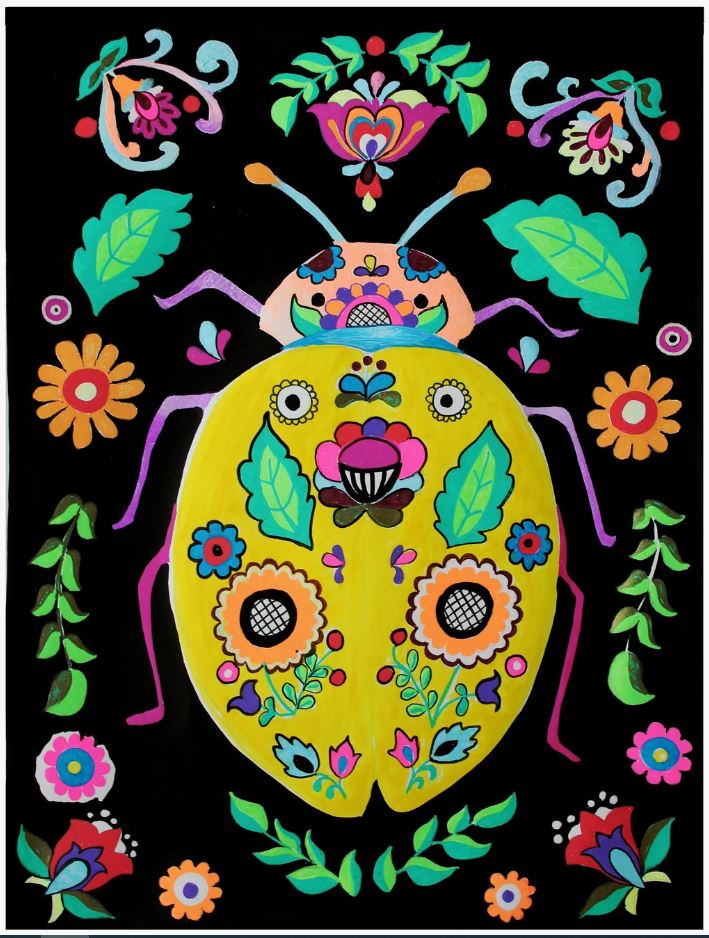
Artist Margo Moore was born and raised in Poland and lives in New York City community her home. Specializing in both abstract and figurative work, her portfolio includes portraits, paintings, and abstract drawings. Her artistic journey has taken her to numerous international and US-based exhibitions, including the Netherlands, Poland, various shows in Chicago, Florida, and NYC. Currently, Margo’s smaller works can be seen on display at NYPL’s 440 Gallery in Brooklyn, NY and at the United Palace in Harlem.
 Gulf Stream Magazine