
by Kelle Groom
Mysophobia
musos, uncleanness; phobos, fear
I’d love to live above ground if possible. Fly to DC, take a cab to my sublet. I’m here for four months for a writing residency. Excited to see the apartment I’ve only seen in photos. Early evening when I arrive. Building squat and square, but massive. Institutional. A place for reformation. Hallways wind around, strangely empty. My door dark. Key slides in, turns. Large, open room to my right stacked with electronics, record albums. Smells as if someone was cooking and burnt everything a long time ago – gave up and left. Like sour clothes set on fire. Yellow, saffron and rot, old garbage left in the sun. Heavy, the smell is tangible, an object.
Around the corner, dark red sauce is splattered thickly on the kitchen walls, stove. The bathroom has a brown-stained tub that fills without a plug. Water rises to my knees as I shower. Cholera toilet so encrusted I’ll scrub it daily for a week – an archaeology of shit runs over my yellow gloves. Mattress on the floor looks dragged from a tenement a century ago. Yellowed, stained primary stripes. Ragged hole cut in the center, apparently for storing items or a home dug by small animals. Another mattress on top, bedding gone except a crumpled olive top sheet on the couch. Was the previous tenant too afraid of the mattress to sleep on it? No towels.
Beer cans, wine bottles beside the desk. Linoleum I think patterned a wispy black and brown until I look closer to find hundreds of roaches ground down. I call my only contact – my landlord’s downstairs neighbor who’d held his keys. The landlord lives on the West Coast, has been gone for years. A constant stream of subletters precedes me. I can loan you sheets and a towel, she said. In the foyer of her apartment is pale, soft light. A cat purrs in the next room. Garlicky air. Music. How can this be the same building? Her place immaculate. Pillows stacked like books. I could fall asleep right here in her entryway.
*
Symptoms: brain fog, frequent bouts of crying, irritability, lightheadedness, rapid heartbeat (palpitations), restlessness, shaking, sweating
The next morning, I open the fridge to six inches of standing water and mold. Produce drawers full to overflowing, a constant leak from above. Under one kitchen cabinet, hundreds of dead roaches and broken glass. I work fast to try to clean it all out, imagine I can make this livable. Not thinking, I dump broken glass and swept-out roaches into plastic garbage bags. A shard easily cuts through, slices my leg. Blood, insects, filth. No Band-Aids or antiseptic.
There’s a big white plastic jar in the dead roach cabinet, pushed to the back. I pull it out, open it on the linoleum. As I turn the lid, I wonder, What kind of poison killed so many bugs? All in one cabinet? What made a roach graveyard? Too late, then, the lid comes off in my hand, inside an orange powder. What kills bugs through a closed jar? Fear I breathe it; I call my landlord across the country, ask, What is the orange powder?
He said, I don’t know. I’ve never even opened that cabinet – it’s behind the garbage can. I try to write, but the furniture gives me hives. Wear long sleeves in case my arms touch the armrests of a chair, the sticky desk. It is impossible to eat. I keep yogurt in the fridge after I drain it with a bucket like a sinking boat. Scrunch the small containers along the side, away from the waterfall splashing in a pot. But I worry about spores.
Above me on kitchen shelves are boxes of soup that reached their expiration years ago. The fridge holds a collection of wet jars – fancy jams and vinegars from some luxurious past. Why hoard so many condiments? The place feels post-apocalypse. Paper bags stuffed with papers stacked around the desk. Two closets: one so jammed it will not open, another heaped with clothes that rise almost to the ceiling.
In glass cabinets are dusty books and martini glasses, brandy snifters. More empty wine bottles. Open bottles of whiskey, scotch. I’m an alcoholic in recovery, and sick of all the booze around. Like some life I could have lived. Store it in the poison cabinet, along with the glassware. Tear a piece of multipurpose copy paper in half, write: I think the white container is full of poison. Place it in a snifter.
Hard to sleep. In the bedroom, my clothes hang on a portable wardrobe rod or folded on a dresser top. Dust layers the wooden floor, bureaus, mirror, broken air conditioner in the middle of the room, a weight bench. Keep the windows open to air the smell: burnt, sopping, foul. It’s late August.
At the opera house in Orlando, once the tank for city water, I’d imagine water all around my desk. An aquarium. Limestone rolling like small bowling balls, chalky white and green, a breath mint for the water. Even with all that water, my office never smelled like this apartment — stagnant with bacteria, their little tails.
At night I can hear people talking outside. Cars. I wish I knew someone. My landlord said he had a friend. I call him. We meet for coffee. He talks about Ralph Nader. He said sometimes there are muggings in our neighborhood, but that shouldn’t stop me from going anywhere. You can walk to the White House, he said. DC’s a small town. Or bike, he said. When I mention the state of the apartment, he seems to find me finicky. In my ID card photo, I’m bedraggled from the walk uphill in a storm, through the river trough of water that ran downhill. Wading to the station, a train, another train, and another walk in rain. My shoes, socks soaked. But in the library basement, in front of the photographer, I try to smile. When I grimace at my laminated face, she said, Everyone thinks I’m a photographer. I’m a government employee. In the apartment, the toilet stops flushing. More small bugs. Something new crawling on the floor.
There are police with assault rifles on my walk. When I walk to the Capitol, police are on top of the building, rifles aimed. Another behind the library, gun barrel pointed downward. There has been a threat, specific, but unconfirmed, of a car bomb as I walk through the city. On the sidewalk, I pass a policeman with his rifle just inches away. He asks, How ya doing? When I answer him, my voice is so slowed down – a record on the wrong speed – I don’t recognize it. In the Capitol I’d been in the old House of Representatives meeting room. It seemed small for all its history. But someone reminded me that men were generally smaller then, and they sat at little desks, the states fewer then, too. But still. The size of a high school cafeteria.
I imagined my apartment here would be something else too. Like my yellow two-bedroom rental house by the ocean in Florida, transplanted to a city. Higher up, but serene with room for Alan to visit, Linda, and Teresa. I thought we might see a ballet. But here there is never room for anyone to visit. There’s barely room for me. Why am I unable to house myself? Why this helplessness? As if I can’t find myself on this map, or even see the map.
At the library, I have metal bookshelves, a swivel chair. Guards x-ray my backpack when I arrive. If there’s food inside it, that’s x-rayed too. I walk through a metal detector with my coffee cup. My place in one book is frozen. A self-help book for obsessive-compulsive disorder, to help me learn how to live with uncertainty. What I read: it said I would have to imagine the world without the people I love. I knew I could never do that. I worry that imagining something may help to make it true, like a wish, a prayer. So how can I imagine what I most fear? What if it helps to make it happen?
I try to detach in the DC sublet, let go of my entire environment. But the burning rot is in the air and furniture, walls. I breathe it. It is on my skin, my tongue. I have to find a way to make it clean.
*
Questions: How often do you think about germs? How do germs make you feel?
I clear out the roach graveyard. Attempt to clean the stove covered in spilled, thrown, exploded food. White walls splashed with it. Bloody brown like thick barbecue sauce. I sleep on the mattress that looks like small animals have eaten through, made homes inside. The guy I sublet from feels bad. Mails me a lovely comforter, expensive sheets. I make the bed. Sleep on the fold marks of stiff new cotton. Try to detach. But underneath and all around is grime, decay. Buy more cleaning products, roll up my sleeves. I speak in an excited manner to the guy I sublet from, I have cleaning products! As if imitating a television character.
I have gloves. Every day I also continue to scrub another layer of other people’s shit off the cholera toilet. At night I wrap myself in the new sheets, under the comforter and try to detach from the rest. Wonder if I could have a germ phobic nervous breakdown in this apartment. I was raised by a mother who was hyper-clean, hyper-germ aware. In our Florida home we couldn’t spill a drop of water on the kitchen counter at night because roaches could be attracted. Here in the DC apartment, the roaches have been attracted.
*
Mysophobia commonly accompanies other phobias: ataxophobia: fear of untidiness, microphobia: fear of small things, nosophobia: fear of disease, thanatophobia: fear of death
A German scholar at the library, Sascha, finds a place I can live. A basement. Cat litter box by the door, just a room with bath. But clean with a closet and a door leading outside – so when it’s closed it’s not like a tomb. No more daily trains – I’m close enough to the library to walk.
In Virginia, a Norwegian photographer will try to cure me of my germ fear with camel spit. His gray Subaru appeared covered in mud – door handles, side mirrors, most of the surface had a tan film. I’d driven him around a safari park where animals roamed free, so he could photograph them from the back seat. During the drive, a camel took the passenger side mirror into her mouth and crunched it, licked the doors. Her dark eye on the other side of my windshield. I understand it isn’t mud all over the car, but saliva. I can’t stand to touch the door handle. But then I can’t get back in the car. The photographer refuses to open it for me from the inside. You need to build your immunity, he says. Lets himself out and heads off to photograph the goats.
Immunity. Maybe I could change my thinking. See each germ, each thing unclean, as something that might help to make me strong. Like Mithridates VI, the King of Pontus in the early years BC, who drank the blood of ducks that fed on hemlock and hellebore to build his immunity to poisoning.
Camels regurgitate their food like cows. After letting it ferment for a couple of days. Camel spit a mix of saliva and vomit. It looks like slimy sand. In the future, I’ll rest my fingertips on the door handle of the photographer’s car. Let them sink into the tan goo. As if at a police station, having my prints taken. Press down, and open the door.
Author Kelle Groom is the author of How to Live: A Memoir in Essays (Tupelo Press 2023), I Wore the Ocean in the Shape of a Girl (Simon & Schuster 2011), and 4 poetry collections. An NEA Fellow, Groom’s work appears AGNI, The New Yorker, and Ploughshares.
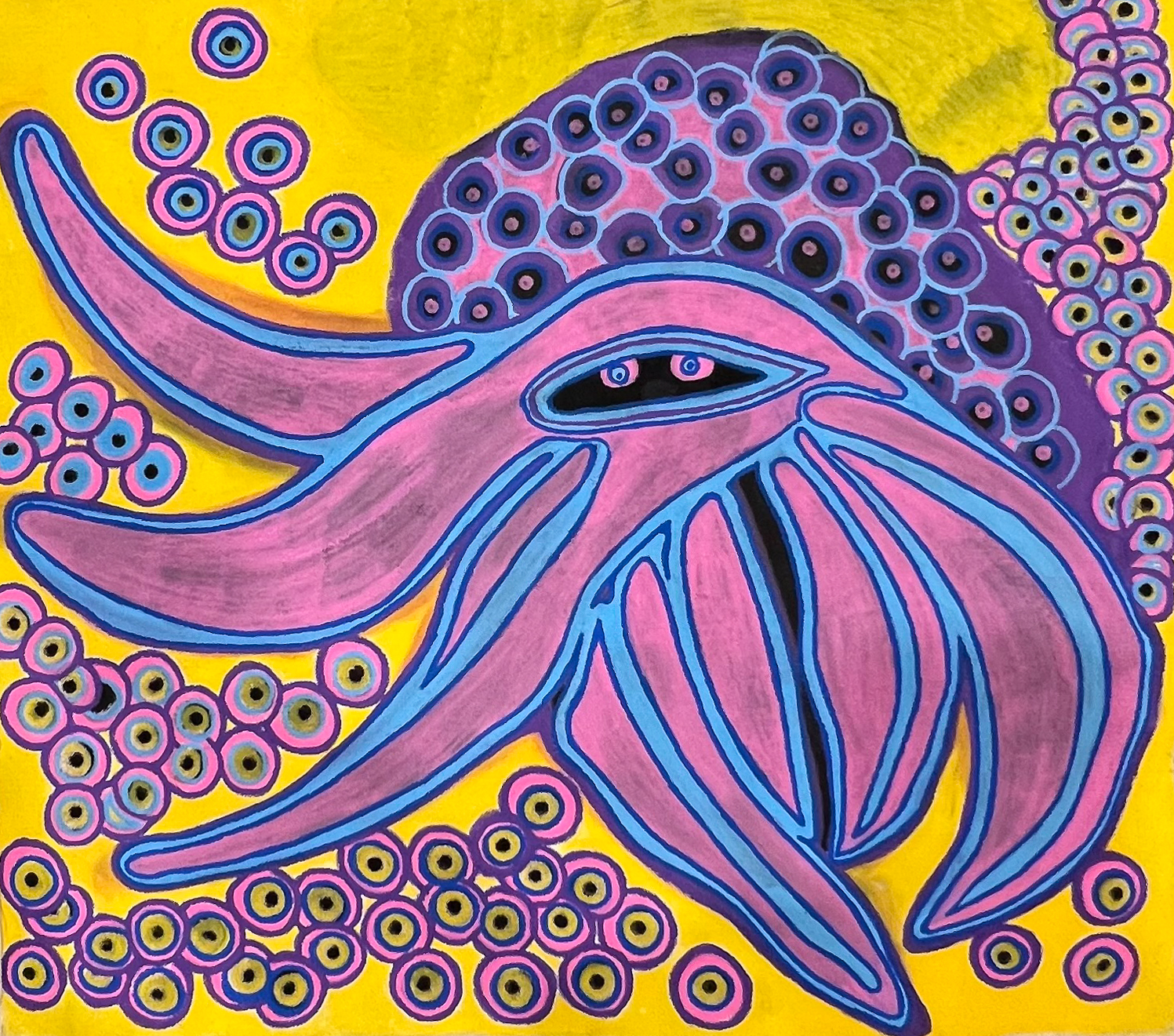
Artist Eric Alexander was born and raised in Miami, Florida. He spent most of his life working in Finance and Accountancy. A natural painter, he has no formal training. “True artistic venture is the ability to purvey images into something you can perceive, with beauty and grace and color.” (Eric Alexander Gasa, 2024)
 Gulf Stream Magazine