
by Randy Smith
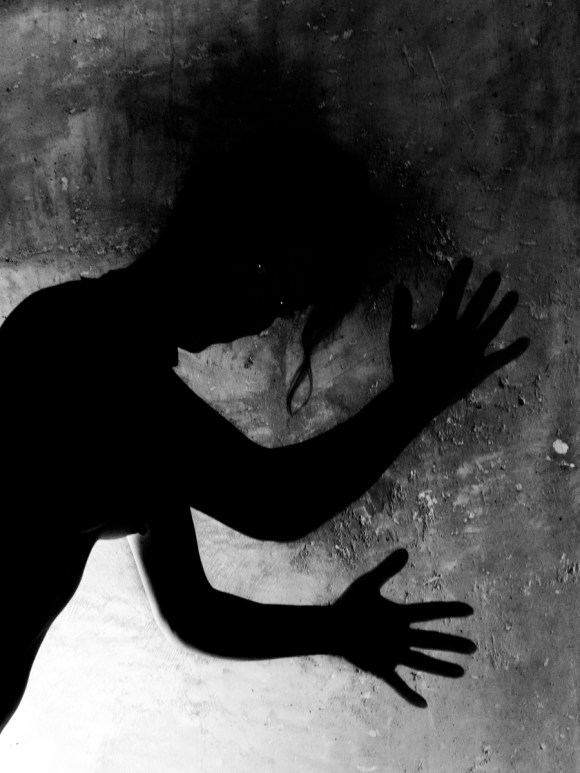
The Sun is Down
The nandina’s briolette-cut leaves and conical white flowering spires paste their dreamy selves against the night in a spellbound collage.
Collage meaning a jumbled collection of impressions, events,
and styles, from French meaning “to glue.”
Night is a pastiche of memory, even when it is the night you are in.
You are the mastic holding together the old sea-green bathroom tile, the native knapped blood flint, the degraded photo, and blue-lined snippets of high-school letters
beneath which love and doubt course multifarious like the radial pain of a
bruising wound.
In a salvaged Army trunk, I store color photographs of my high-school girlfriend and me. But, decades of random photons have broken the molecules of pigments in the prints—the cyans and yellows of love and loss too excitable to persist. The moments we thought framed and fixed have shifted red,
like the infrared-leaning light of fleeing galaxies near the edge of the
known universe, as if we have been moving farther and farther apart, faster
and faster, all these years.
You and the one you thought you would marry, her perfect skin Persian and plastic to your once-young, once-hard body. Her small breasts not much more to clutch than your own, as if she was an Eve still growing fresh from your rib. You two who coupled by a tree in a wood by a stream under the watchful, wary eye of a Black Angus bull, powerful in all his muscled quarters like the mythic minotaur.
Male and female, man and beast, siren and song, breast and rib He created
them.
But for you in your quiet room with the brazen window, it is still night. And still now.
Or the memory of now.
The neighbor’s security light—such harsh, rectangular treacle—fills the edge of your yard with its halide glare from the apex of the eaves, pushes against what cannot be pushed against because security arcs without a pulse, unlike the night which offers you promise and pulses with life multitudinous.
And with immaculate song.
Amorous male crickets by the thousands raise a collective, continuous note with their winged scrapers and files, a sound heard by females with tympanums on their front legs. Think in the night about hearing the world with your legs! With arms, gut, and feet. Of being drawn ineluctably to a destiny as beautiful, beshadowed, and consuming as cricket amorets.
In—not.
Luctari—to struggle.
But you struggle to hold many worlds together. Inhabiting the border between light and dark and storiating the walls of your timber-framed cabin or damp, descending cave are not for the faint of heart. Here, you, the shamanic stick-man with a bird head, enact the rapt communal hunger for bison blood and the fortuitous homing of a thrown spear. Here, you the French teen, with your embellished falling dog, lead Henri Breuil to the caves of Lascaux, to the Chamber of Felines to trace engravings of big cats.
Horse, bird, bison, stag, ibex, auroch, cave, dog, priest, and shaft of the
bird-man.
On the interstate, young men gun crotch rockets through the straightaway, airlifting their bikes in power wheelies at 100+ mph, passing families in out-of-state minivans, silent husbands and wives stunned to new life by proximal danger, as if something reckless does not already pass through them beneath the steady flow of utility bills, small talk about summer camps, and the sidling cough of clearing throats.
Elsewhere, the moon tells lovers to kiss by a lake lapped with night breeze or on an open plain beneath an inked slab where points of light receive the stories we want to tell. These lovers and lights have not faded yet.
Still in a vast movement.
Who-are-you? becomes a single word and hovers as the last spirited sound before you sleep.
You must find the selves who speak for you,
the one and only lost-and-found Self.
I and You. Who speaks to whom?
Beneath we exists the I Am.
Author Randy Smith directs the BFA Program in Creative Writing at Belhaven University in Jackson, MS. He has published poetry in Ruminate, Tupelo Quarterly, Prometheus Dreaming, and Yemassee. In 2018, two of his poems were finalists for the Tupelo Quarterly Open Poetry Prize judged by Denise Duhamel.
Artist Simon Beraud lives and works between Paris, Brussels and Tel Aviv. His work revolves around questions intrinsic to human existence: identity, roots and uprooting, borders, love. and solitude, memory… Through his images, he invites the viewer to find connections with these questions that drive him. More broadly, he is interested in the evolution of our perceptions and of a collective memory: in the impact of the environment on the psyche and of the psyche on the environment.
 Gulf Stream Magazine