by Ellie Gomero
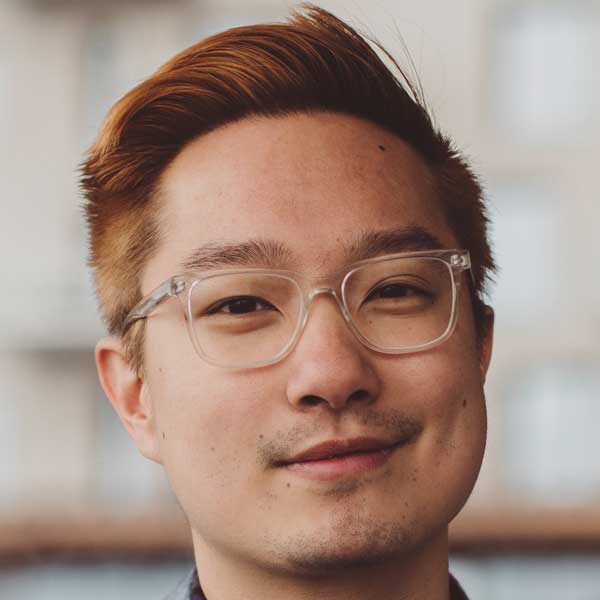
Chen Chen is a writer, teacher and editor his second book, Your Emergency Contact Has Experienced an Emergency, is available from BOA Editions and Bloodaxe Books (UK). A finalist for a Brooklyn Public Library Book Prize and a best book of 2022 according to the Boston Globe, Electric Lit, NPR, and others, it has also been named a 2023 Notable Bookby the American Library Association. His debut, When I Grow Up I Want to Be a List of Further Possibilities (BOA, 2017; Bloodaxe, 2019), was longlisted for the National Book Award and won the Thom Gunn Award, among other honors. Chen is also the author of five chapbooks, including Explodingly Yours (Ghost City Press, 2023), and the forthcoming book of craft essays, In Cahoots with the Rabbit God (Noemi Press, 2024). His work appears in many publications, including Poetry, Poem-a-Day, and three editions of The Best American Poetry (2015, 2019, & 2021). He has received two Pushcart Prizes and fellowships from Kundiman, the National Endowment for the Arts, and United States Artists. In the interview below he discusses his most recent book of poetry Your Emergency Contact Has Experienced an Emergency with Gulf Stream’s poetry editor Ellie Gomero at the 2023 Miami Book Fair.
Their conversation has been edited for concision and clarity. _______________________________________________________________________
Ellie Gomero: Hi, I’m Ellie Gomero. It’s so nice to meet you. I’m with FIU’s Gulfstream and in this issue of our literary magazine, we are really looking to highlight, queer voices, POC voices, and just people who are queering the narrative and I feel like that’s all you!
CC: Yeah!
EG: You encompass all those categories and so it’s really an honor. It’s really an honor to be here. Thank you for taking your time and for accepting this interview!
CC: Thank you! Happy too!
EG: So I just wanted to begin with the fact that so many young poets, especially in MFA programs, feel the need to be really hyper lyrical and serious in their writing, especially in college in general. But you write about so much, and yes, you’re extremely lyrical and vulnerable, but you also include joy and humor and sex and shit, and alongside all of this other beautifully vulnerable stuff. So you even go so far in your poem, winter, to pose the question “is shit, is scat, more or less literary than poop?” How do you manage to strike that balance between humor and vulnerability and lyricism?
CC: Yeah, that’s a great question. I think actually often it’s a challenge to juggle all of those elements in a single poem. It’s also in a collection, but it’s just really important to me to write from and about a whole range of emotions, because that, to me just feels truer to life than trying to present just one kind of tone. So it’s really important to me to have that range. But yeah, I wish I could say that it just comes naturally, but often it’s more of a whole revision process to kind of find that range and kind of the right balance between those different elements. So a lot of it happens just through trial and error and through experimentation. And I wish I could say that once you write a poem like that, then the next one will come more easily. But that’s not really the case because I think I’m also trying to do something different in each poem, and I hope it comes across that way. The previous poem can’t just be a template for the next one, but I do learn a lot from each poem that I work on and I sort of see, oh, this is how funny it can go, or this kind of pop culture reference works in this way. So it does give me some sense of what’s possible and what I might try next, but there are also plenty of drafts that don’t really go anywhere. So I would just encourage people, other writers to read really widely, pay attention to what you like, but also what you don’t like because that can be really clarifying and challenge yourself to maybe write in some ways that don’t seem like they come naturally to you, but maybe something from your own voice really opens up when you do that. Because I didn’t start off writing in this way. It was really just trying it and seeing what might happen. So I think it’s important to be really open.
EG: And that beautifully takes me into what I wanted to ask the next which is what are the lines that you choose not to cross in your poetry? How do you decide what to share and what to keep to yourself? How do you strike that balance?
CC: Yeah. I think because a lot of my writing is very autobiographical and drawn from my own real experience, I do think a lot about what to include, what to share and what not. And it also changes over the years. So again, I would recommend trying to give yourself as much permission as possible to just write. And then taking a closer look at what you’re writing, maybe take some time away from it too to gain a fresh perspective and at that point you can, I think, make a better decision about whether this is something you want to share with other people. And there are things that I wrote in grad school that I realized were really just for me and they where a way for me to process trauma or other difficult experiences from my past and from my childhood in particular but I didn’t need to publish that. And in some cases, I didn’t even need to bring it to workshop. I didn’t need really anybody else to see it. It was really just for me to think about something. So I think that becomes clearer the more that you write. I’ll just give a quick example. Something that I realized as I was writing a lot about my relationship with my parents and especially my mother, it became clear that I really wanted to focus on that relationship, sort of like what kind of role has she played in my life rather than writing about her, even though there are things that I know about her from many, many conversations and observations and from other family, but there are parts of her story that I don’t feel like are mine to tell from her past or her relationship with other people in our family. So that feels like a boundary, and maybe that’s not the same kind of boundary for someone else, but I think it’s important to reflect on that, what are the parameters around the subjects, especially if you are writing about people and people who are still alive and they can tell their own story. So I feel like the focus for me is in our relationship.
EG: And that actually really perfectly takes me into the fact that in this book, you talk about your strenuous relationship with your parents because of your queerness. So reading about this in your book, alongside so much joy, alongside so much queer joy, very specifically, was really beautiful. And yes, you talk about sad moments in queer history, you talk about the stress of this parental relationship, but you also express a level of joy and trueness to the self that can be so difficult, especially given that relationship, especially given that you are a person of color. And I feel like that definitely plays a role in being able to come out sometimes just the culture around it. So I wanted to ask, how do you deal with that relationship and also have so much confidence in your self-expression and so much joy to the point where you even make it a point to end this book on a poem titled “The School of Joy”, even though it’s not necessarily a joyous poem. What would you say to other young queer poets and with similar family lives just about how to go about cultivating that kind of joy in their writing and highlighting it? I feel like right now, especially in queer stories, we tend to only get the highlights of tragedy and not as much really getting to experience the joys.
CC: Yeah, there’s so much I want to say about this. It’s a great question. Thank you. Yeah, I think, well, first of all, I think it’s always worth reaching for joy. Whatever that means to you, whatever that looks like for you, that could be very different from my own experience. But I’ll also say, and there’s a poem that kind of addresses this in your emergency contact where I’m reflecting on coming out and the centrality of that action for many queer people. But I think that’s not the possibility or the reality for a lot of queer people too. It’s not safe to always come out. And I think in a lot of white queer media coming out is depicted as a requirement. You’re supposed to do that and it’s supposed to be this really triumphant and liberating moment. But I don’t think it always looks like that for many people. And I think when it remains unsafe to do so, that’s not information that you really owe anybody. And I think that’s okay, and I don’t think we hear that enough. There’s this idea I think is really rooted in a lot of homophobia that, oh, if you’re not out, then you’re lying to people. But that’s because of how messed up the world we live in is. But that doesn’t allow for certain truths to be shared or certain conversations to be had or not in the ideal ways that one might imagine. So I think, yeah, if you need to protect yourself by not being out, that’s a very legitimate way to be yourself. To still be yourself actually. And if there’s certain relationships that you want to preserve by not being out, I think that’s a completely legitimate choice but in reality, it’s not always such a choice. So yeah, I’ll start by saying that because I think sometimes a lot of mainstream white queer narratives overemphasize being out, and there are other ways to be liberated and to live in the ways that you want to. I think that’s why found family and community become so important. There are other places and there are other people that you can connect with and maybe live more openly. But it was always something that struck me as a bizarre dichotomy in a way. It’s either out or not out, but I think the reality for many people is that you’re out in certain circumstances, but not others. I think this is true in many places, including very supposedly liberal places in the US where people don’t feel comfortable being out at work, or they feel like that’s your private life, so why should you have to share that with people who maybe don’t deserve to know that information, that part of you. So I think, yeah, the reality is more that it’s a mix because of the kind of circumstances you have. So I think I lost track of the question.
EG: It’s okay. I asked a lot in one. It’s okay. I am a run-on sentence girly, so it’s hard. But basically just how do you go about reaching for joy in this? So there is a dichotomy of you don’t always have to be out to be queer and you don’t always have to be out to experience queer joy. And I feel like queer joy is something you come back to a lot in this book. So I just wanted to ask how you do that?
CC: Yeah. Another thing I’ll say is I remember reading while I was working on these poems, I was reading Sarah Ahmed’s book, living a Feminist Life, and I think she’s an incredible thinker, theorist, and writer. And there’s this really beautiful moment in that book, a more personal story that she shares about having to basically set a boundary with her father and not really have him in her life anymore after he kept making these really homophobic remarks, and she talks about sharing this story with other people and people immediately feeling very sad for her and wanting to be very sympathetic. But for her, it was actually a source of joy to set that boundary and I was just so moved by that story and how she talked about it. It just made me think about the fact that often in queer people’s lives there are things that we’re supposed to view as a kind of tragedy or a lack when in fact it could be a source of joy or a source of empowerment, a source of freedom to live in the ways that we need to. It makes me think of something that Ocean Voung said about queerness and how it’s often seen as a deviation from the norm and a deprivation, a lack. But he says, why not see it as abundance as actually something that gives you life and connection? So I love that notion that really kind of flips this heteronormative script that we’ve been given that’s imposed that if you don’t live your life these ways, if you don’t do these things, then your life lacks purpose or meaning or joy. But actually, I think a lot becomes possible when you pay attention to what is it that you actually want? What is it that you actually need to be alive?
EG: Yeah, that’s so gorgeous. And I agree. I think it’s way more abundant than it is a deviation or a lack and I think that that comes through really beautifully in your book. So I wanted to ask you about the quote that you chose for the intro of the book by Justin Chin “Lick My Butt cause I’m an angry ethnic fag and I’m in so much pain, so lick my butt” Why this specific quote?
CC: I love that poem. So yeah, the poem by Justin Chin is called Lick My Butt, and I highly recommend checking out the whole thing. You can find it online, but yeah, I just remember coming across that poem and there’s such an abundance in it. Even as he’s talking about pain and difficulty in his own life, there’s still such a beautiful awareness of these sources of joy and aliveness. The whole poem just vibrates with this keen life and deep desire for more, and just the recognition that there can be more that you can want more, that you can ask for more, I think is a really radical position actually as a queer person, I think we’re often made to feel like we shouldn’t take up too much space, especially as a queer person of color, it’s like you should shrink yourself and keep your head down and just work hard and not cause trouble, and as though that is the only way. But I think in Chin’s work, there’s such an embrace for that desire for more. That you can imagine more for yourself. You can take up more space, and you can be bold about how you do that. So yeah, it’s one of those poems that makes me braver every time I read it. That gives me courage. And I don’t think we don’t talk enough about how poems can do that because it’s not like you just read it once and you have that experience that can be very moving, but the poems that really affect you, you carry them with you and they become a kind of resource that you draw on. I can think about those lines from Chin’s work whenever and in any situation that I’m in, whatever kind of interaction I’m having or how I’m experiencing the world. I can carry those lines with me and know that there is something beautiful and bold, and it might not be exactly how I’m feeling right now, but I know that there’s something within me that can reach that.
EG: And I think your work does that for other people as well. I think that for me and so many other people, I think your work is such a source of inspiration and courage, and it’s so beautiful, especially because you have this way of playing not only with subject matter and emotion, but playing with the work itself on the page. You utilize so much hybridity and forms, and you play with language not just in English, but including Chinese characters. You utilize ellipses. You take on so many interesting forms, like the question and answer form, a doctor’s note, you even take on the seasons. Is this level of hybridity within your work something that was an intentional move that you strive for? Is it something that just you found yourself drawn towards that felt just like a natural course for your work? Was there a specific intention at play?
CC: Yeah, I mean, I love poetry for just how much you can play with form and how language sounds and appears on the page, and I think I have a very restless kind of mind and personality. So I like pushing myself to experiment formally a lot. Some of the experimentation in this book, like the bilingual poems where I was using Mandarin and English, it was really important to me to do that. I’d been thinking about it for a while, and I had dabbled in it a bit before, but I was always sort of nervous, because I’m not fluent, and so I felt like I had to wait until I am fluent or much better at the language to use it in poems. But then I realized I’ll probably be waiting forever to get to that point. And it started to feel weird actually to not use both languages because that’s what I grew up speaking. I grew up in a multilingual household. My family was always speaking more than one language. I was always hearing more than one language. So it started to feel strange and kind of self alienating to not write in the way that actually reflects my whole linguistic self. So I thought even if it’s imperfect or even if it’s very basic mandarin, it’s very conversational, I still wanted to feature that. That became really important to me in a way to be able to see more of myself on the page because I felt like I’ve been writing for a while now, but I’m not using everything. That’s often how I think about form in general and other things I want to try out. For instance, some of the poems I’m working on now, I’m really playing with spacing on the page. Some of that actually goes back to, I remember reading Richard Siken’s book Crush in High School and just becoming obsessed with it, like many people, and just how the poems look on the page, the lines are all over the place and really stretch across the whole page. There’s really weird indentation and spacing, and they have this really ragged, unpredictable look to them. I’ve been wanting to write like that for a long time, but I really didn’t know how to go about it. I feel like I’m finally now figuring out my own way of using indentation spacing some pretty wild ways, I think. Yeah, so it’s a lot of fun.
EG: Yeah, I love that. Especially I wanted to ask, do you find yourself wanting to take more leaps in language and form and leaps towards further hybridity in your next book?
CC: Yeah, definitely. Yeah, I want to keep playing. I just really feel like I wouldn’t keep writing even when I’m writing about very serious subjects. But I wouldn’t keep doing it if it weren’t fun on some level. Even when it’s challenging, it still feels like there’s a kind of joy in that. There’s a joy in the challenge. I think joy is not just synonymous with happy. I think about this a lot. I think joy can actually be something that can come out of a frustrating experience or a kind of battle because of what you get to discover from it and the surprise that happens. I think when you really push yourself to look at yourself differently, look at the world differently, which I think is often, to bring it back to queerness of course, I think that’s often kind of the position that we’re in as queer people. You have to look at things from one side and kind of askew and not straight on because you have to figure out how do I make things happen when I’m not doing things in the ways that are expected of me? How do I still make things happen? How do I invent a way to live that is actually right for me? I think queerness involves a lot of invention and imagination out of necessity a lot of the time.
EG: And I think that using those big cesuras and taking up space on the page is also really powerful, metaphorically for this idea of wanting to take up space as a queer person and wanting to just take up space with your story and feeling emboldened to do so. If you could boil it down to just one piece of advice for young queer poets, for people who want to write poetry in these spaces, what would you want to say to them?
CC: Yeah, I would say find your people. I think it’s really important, and depending on where you live or what your circumstances might be, that could take the form of books. Actually, a lot of my early experiences with the queer culture and literature history was through reading. Just finding books that gave me alternatives and helped me cultivate that imagination to believe that another life as possible. So I think librarians are so important. I think funding libraries and librarians is super important cause thats where you find the knowledge early on if you don’t have that kind of queer community around you. It might take a while to find those people, but I think again it’s worth reaching for that joy however you can. I think it makes such a difference as a writer. I used to think it’s okay to just be solitary because, as a writer, you do spend a lot of time just by yourself reading and writing. But no, I don’t think that’s enough. I think you do need other people. It’s so wonderfully unexpected when you find the people you need. I think that’s what writing’s for too. I think that’s what poetry is for actually, is to help you find people.
EG: Yeah, creating community. I completely agree. I don’t want to keep you too long. I know that you have your events, but speaking of community and speaking of other people, you’re doing a performance / reading / interview with Sam Sax? Correct? How did that come to be?
CC: So we actually first met a while ago in 2014. It was at this writing retreat. So we’ve known each other for a while and we’ve actually read together before at the Miami Book Fair, I think in 2018.
EG: Oh, wow.
CC: For a different kind of event. So this is a lovely kind of reunion.
EG: Oh Nice.
CC: Yeah. Just so glad that we’ve stayed in touch and I’m excited about this new work.
EG: You both are such incredible poets and it’s so incredible for me to be able to pay witness to it and be able to be there and to get to see you both in the same space, especially because I have come into contact with both of your work at such different points in my life and Sam Sack’s work in spoken word was so impactful to me as a young person, and your work has been so impactful to me as an older person, and to have both of you in the same room is like fucking iconic. I’m very excited about it. I was so starstruck when I read that you guys were going to be performing together. I was like, holy shit. But yeah, I don’t want to keep you. I know you have to get going, but thank you so much for being here. Thank you for taking this time.
CC: Yeah, these questions were really great. Thanks. It just makes me very glad that I’m here. Again, this is why I’m writing so I can reach people, so thank you!
_______________________________________________________________________
Chen Chen holds an MFA from Syracuse University and a PhD from Texas Tech University. He has taught in UMass Boston’s MFA program and at Brandeis University as the 2018-2022 Jacob Ziskind Poet-in-Residence. Currently he is core poetry faculty for the low-residency MFA programs at New England College and Stonecoast. With a brilliant team, he edits the journal Underblong; with Gudetama the lazy egg, he edits the lickety~split. He lives in frequently snowy Rochester, NY with his partner, Jeff Gilbert and their pug, Mr. Rupert Giles.
Ellie Gomero is a poet, a feral woman, and a sad girl at heart. She is currently studying at Florida International University, to receive her master’s degree in Poetry. Her poems have been published in Rust + Moth, The Orange Island Arts Review, and have received awards / recognition from The Academy of American Poets, Fred Shaw Poetry Contest, Bluapple Poetry Foundation, and Scholastics.
 Gulf Stream Magazine